
Odin (Old Norse Óðinn) is the chief of the Aesir and the most powerful god in Norse mythology, ruling from Asgard alongside his wife, the goddess Frigg, the mother of his son Baldur. Odin is also the father of Thor, born to Jörð, whose name simply means “Earth.” From his high seat Hliðskjálf, in his hall Valaskjálf, Odin can look out over all the worlds and see what everyone in them is doing.
His own family tree runs deeper still. Odin is the son of Borr and the giantess Bestla, and the grandson of Buri, the very first of the Aesir — which makes Odin part giant himself, on his mother’s side. Together with his brothers Vili and Ve, he shaped the world. Beyond Baldur and Thor, he fathered Vidar with the giantess Gríðr, Vali with Rind, and Höðr, Baldur’s brother.
Snorri’s Skáldskaparmál also calls Bragi, the god of poetry, a son of Odin — a fitting son for a god who once stole poetry itself out of the side of a mountain.
Almost everything that makes Odin the most powerful of the gods, he did not simply have — he paid for it, one way or another. He gave up an eye for a drink of wisdom. He hung from a tree for nine nights to learn the runes.
He lied and seduced his way into stealing the mead that made poetry possible. And for all of that wisdom, it still is not enough to save him when Ragnarök finally comes.
Odin and the Creation of the World
Before Odin ruled anything, he had to make the world he would rule. According to Snorri’s Gylfaginning, Odin and his brothers Vili and Ve killed the primordial giant Ymir, the first living being, and built the world out of his corpse: his flesh became the earth, his blood the sea and lakes, his bones the mountains, his skull the sky itself, held up at its four corners by four dwarves. His brains, thrown into the air, became the clouds.
The older poems Vafþrúðnismál and Grímnismál describe the same world made from Ymir’s body, but only Snorri says outright that the gods killed him. And because Odin’s mother was a giantess, the scholar John Lindow points out, Ymir was Odin’s own kin — the world begins with a killing inside the family.
Humanity came afterward, almost as an afterthought. Walking along a shoreline, three gods found two lifeless pieces of wood, Ask and Embla, and gave them life. In Völuspá, the three are Odin, Hœnir, and Lóðurr, and each gift is named: Odin gives önd, “breath” or “spirit,” Hœnir gives mind, and Lóðurr gives blood, warmth, and healthy color. Snorri tells it differently. His three are the sons of Borr — Odin, Vili, and Ve — and he lists the gifts in order (spirit and life; mind and movement; appearance, speech, hearing, and sight) without saying which brother gave which.
Odin’s Many Names in Norse Mythology
Odin is rarely called just “Odin” in the old poems. He has more than 150 names, taking a different one in nearly every myth and often traveling in disguise, and each describes a different side of him. For the god of poetry, that is fitting. The fullest list comes from Grímnismál, and the story behind that poem explains why. Odin and Frigg once argued over which of two foster-sons they had each favored, Agnar or Geirröd, had turned out the better king. To settle it, Frigg tricked Odin: she sent her servant Fulla ahead to warn Geirröd that a dangerous sorcerer was coming.
When Odin arrived at Geirröd’s hall calling himself Grímnir (“the masked one”), Geirröd had him seized and set between two fires for eight nights, refusing him food or water. Only Geirröd’s young son — also named Agnar, after his uncle — took pity and brought the stranger a drink. In gratitude, Grímnir began to recite who he really was: name after name after name, revealing at last that he was Odin himself. Geirröd, realizing his mistake too late, stumbled and fell on his own sword. John Lindow compares the scene to Odin hanging on the tree in Hávamál: in both, pain and deprivation are what lead him to wisdom.
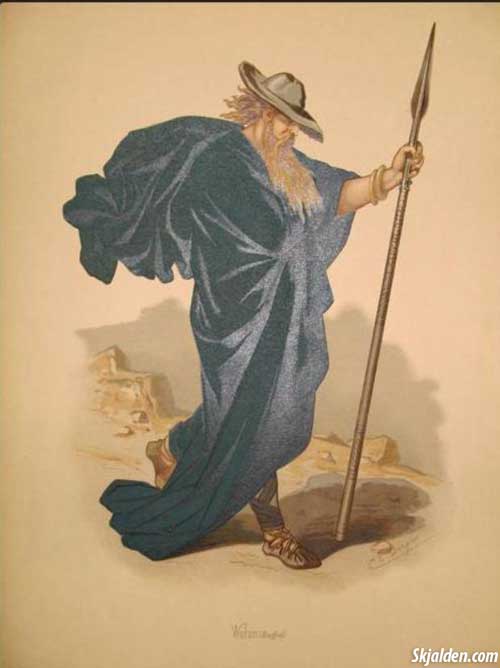
Among the names Odin recites in that same speech are Ygg (“the terrible one”), Þriði (“the Third”), and dozens more tied to war, disguise, and wandering. Elsewhere he is the Wanderer — a hooded, one-eyed traveler who turns up in the middle of other people’s stories to test or advise them, exactly as he did to Geirröd. J.R.R. Tolkien said as much himself: he described his own character Gandalf as an “Odinic wanderer,” and the resemblance — the staff, the hood, the wide-brimmed hat, the habit of arriving in disguise — is not a coincidence.
His most famous title, the Allfather, comes to us mainly through Snorri, who opens Gylfaginning by naming Alföðr as the foremost and eldest of the gods. The scholar Walter Baetke argued that Snorri built Odin up into a single all-father partly on a Christian model — a reminder that Odin’s place at the head of the gods is clearest in the sources written down in the thirteenth century.
The name Óðinn itself comes from the same root as the Old Norse óðr, a word that means something closer to “fury” or “poetic ecstasy” than simple anger — the same frenzied inspiration a poet or a berserker might feel. John Lindow renders the name as something like “leader of the possessed.”
This is not just a modern reconstruction: an 11th-century German chronicler, Adam of Bremen, described the Scandinavian god Wodan with the exact same idea, writing “Wodan, id est furor” — “Wodan, that is, fury.” The word survives today, too. “Wednesday” comes from the continental Germanic form of Odin’s name, Woden, by way of the Old English “Wōdnesdæg” — Odin’s day.
The Mead of Poetry
One of Odin’s boldest thefts explains where poetry itself is supposed to come from. After a war between the Aesir and Vanir ended in a truce, both sides sealed the peace by spitting into a shared vat — and from that spit, the gods shaped a being named Kvasir, so wise he could answer any question put to him.
Two dwarves, Fjalar and Galar, murdered Kvasir, told the gods he had choked on his own wisdom, and drained his blood into two vats and a kettle, mixing it with honey to brew the Mead of Poetry: whoever drinks it becomes a poet or a scholar.
The dwarves’ luck ran out when they killed a giant named Gilling and then his wife. Gilling’s son, Suttung, forced the dwarves to buy their lives with the only thing valuable enough to matter: the mead itself. Suttung hid it deep inside a mountain, Hnitbjörg, and set his own daughter, Gunnlöd, to guard it.
Odin wanted it anyway. Traveling under the false name Bölverk (“Evil-doer”), he tricked Suttung’s brother, Baugi, into drilling a hole into the mountain with an auger named Rati, then turned himself into a snake to slip through the gap. Inside, he spent three nights with Gunnlöd, and afterward she granted him three drinks of the mead — except each of Odin’s drinks drained an entire vessel.
With all three empty, he turned into an eagle and flew for Asgard, with Suttung close behind in eagle shape of his own. The gods set out vessels, and Odin spat the mead into them — but Suttung came so close that Odin let some of it out behind him. That portion, Snorri says, is the share that goes to bad poets. Hávamál ends the episode more bluntly: Odin left Suttung cheated and Gunnlöd in tears.
Almost all of this detail is Snorri’s. The older Hávamál knows Gunnlöd, the auger, and the name Bölverk, but not Baugi, the chase, or the bad poets’ share, and it seems to treat Óðrerir as the name of the mead itself. Most scholars now accept that it was Snorri who turned Óðrerir into a kettle.
The Price of Wisdom
Odin has only one eye, and the missing one was a deliberate sacrifice. To buy a single drink from Mímir‘s well, where wisdom lies hidden, Odin left one of his eyes in it as a pledge. The seeress in Völuspá says it outright: she knows where Odin hid his eye — in Mímir’s famous well. Mímir himself is harder to pin down.
The poems know only “Mím’s head” and “Mímir’s well.” In Ynglinga saga, Snorri has the Vanir behead Mímir and Odin preserve the head to consult, while in Gylfaginning Mímir drinks from the well with the Gjallarhorn. More than one figure may have merged into the Mímir we know today — and his name, fittingly, is related to the word “memory.”
The runes cost him even more. In Hávamál (“Words of the High One”), Odin tells the story in his own voice: he hung for nine full nights on a wind-swept tree whose roots no one knows, wounded with a spear, “given to Odin, myself to myself,” with no one to bring him bread or a drink.
The poem never names the tree, but it is almost certainly Yggdrasil — and the tree’s name may even record the act. “Yggdrasill” is generally read as “Yggr’s horse,” Yggr being another of Odin’s names, since a gallows could be called the horse the hanged man rides. Then, screaming, he took up the runes and fell back from the tree.
The very next stanza has Odin learn nine powerful songs from his giant uncle, Bestla’s brother, and take a drink poured from Óðrerir — the precious mead again. Lindow suggests one way to read the two stories together: Odin’s spirit traveled to the land of the giants and took the mead while his body hung on the tree. Either way, the runes were a secret he nearly died to receive, not one he was ever simply given.
Odin’s Wisdom Contest with Vafthrúðnir
Odin’s wisdom shows up again in Vafþrúðnismál, where he travels in disguise, calling himself Gagnráðr, to challenge the giant Vafthrúðnir — said to be the wisest of all giants — to a contest of knowledge. The stakes are their heads: whoever answers a question wrong, or cannot answer at all, loses.
The two trade questions about the origins of the world, the fates of the gods, and what happens at Ragnarök, and Vafthrúðnir answers every one of them correctly.
Odin wins anyway, by asking a question no one but he could possibly answer: what did Odin whisper into his son Baldur’s ear before Baldur was laid on the funeral pyre? There is no honest way for Vafthrúðnir to answer that — only Odin knows, since only Odin said it — and the giant realizes at that moment exactly who he has been talking to.
No surviving source ever reveals what the words were. It is less a test of wisdom than a demonstration that Odin will win a wisdom contest by any means necessary, fair or not.
Baldur’s Dreams: Odin Wakes the Dead for a Prophecy
Odin’s need to know things extends even to raising the dead. In the poem Baldrs draumar (“Baldur’s Dreams”), Baldur began having dreams that troubled him — dreams the gods rightly took as a warning of his coming death — and Odin did not wait for an answer to come to him.
He saddled Sleipnir and rode down toward Hel. At a grave by the eastern door of Hel’s hall, calling himself Vegtam and chanting a spell for the dead, he woke a long-dead seeress and forced her to speak, over her protests that she had lain dead a long time, snowed on, beaten by rain, and soaked with dew.
She answered him anyway, piece by piece: the mead in Hel’s hall was already brewed and waiting for Baldur, and Baldur would die at the hand of Höðr. The details most people know — Höðr’s blindness, the mistletoe, and Loki’s trick — are not in the poem at all; they come from Snorri.
The seeress added one more thing: Baldur’s death would be avenged by a son Odin had not yet fathered, born to Rind, who would kill Höðr when only a single night old, refusing to wash his hands or comb his hair until the revenge was done. That son is Vali. Only when the seeress realized who she was really talking to — not a traveler named Vegtam, but Odin himself — did she refuse to say more, telling him to ride home proud, because no one would wake her again until Loki broke free of his bonds and Ragnarök came.
Odin and the Forbidden Magic of Seiðr
Not every kind of magic Odin practices is treated with respect, even by Loki, Odin’s sworn blood brother. In Lokasenna, Loki publicly mocks Odin for practicing seiðr — a form of magic and prophecy strongly associated with women — beating a drum like a seeress on the island of Samsey, today’s Samsø in Denmark. It was ergi, Loki jeers, unmanly, for a god to have done so.
Snorri’s Heimskringla gives the practice a specific origin: the goddess Freya, one of the Vanir, first taught seiðr to the Aesir after the war between the two families ended. Snorri adds his own uneasy verdict — that the art brought so much ergi with it that men could not practice it without shame, and so it was taught to priestesses instead.
Odin practices it anyway, seemingly untroubled by the taunt. It fits the same pattern as everything else about his wisdom: he does not care whether the price is an eye, nine nights on a tree, three nights in a giant’s mountain, or his own reputation, so long as it gets him something no one else has.
The same scene in Lokasenna reveals something else about Odin and Loki: the only reason Loki gets a seat at the feast at all is that he and Odin once became blood brothers, mixing their blood together. Loki reminds Odin that he swore never to drink unless Loki was served too, and Odin, rather than deny it, tells his son Vidar to stand up and make room.
It is one bargain Odin keeps at a loss — in the same poem, Loki boasts to Frigg that he is the reason Baldur never rode home. John Lindow suggests Odin swore the oath to head off trouble with Loki in the first place. If so, it failed.
Odin’s Powers and the War God
Much of what we know about Odin’s powers comes from Ynglinga saga, where Snorri recasts Odin as a human chieftain from the east so skilled in magic that people later worshipped him as a god. There, Odin can change his shape into animal or human form at will, the same way Loki can.
He speaks only in verse, and so persuasively that everyone who hears him believes that what he says is true. He can put out a fire or calm rough seas with a word. In battle he can blind, deafen, or terrify his enemies, make their weapons strike no harder than sticks, and drive his own men into a berserk, bear-strong rage.
The same saga describes a practice known as hamfarir (“shape-journeys”): Odin could send his mind out in the form of a bird, a beast, a fish, or a snake to travel to distant lands while his body lay behind as if asleep or dead. Lindow compares it to the trance journeys of shamans, such as those described among the Sámi in the medieval chronicle Historia Norvegiae. Through seiðr, Snorri adds, Odin could also send death, bad luck, or illness to those who crossed him.
The mythological Odin has his own list. Hávamál closes with Odin naming eighteen charms he knows, one by one, in a section scholars call the Ljóðatal (“list of songs”). Among them: a song to heal the sick, a song to dull an enemy’s blades, a song to slip free of fetters, a song to stop an arrow in flight, a song to calm the wind and the sea — and, twelfth, a way to make a hanged man walk and talk with him, fitting for a god who once hung from a tree himself.
Odin refuses to reveal the eighteenth at all, saying he will never teach it to anyone except the woman in his arms, or perhaps his sister — the one secret, out of everything else he has paid for or stolen, that he keeps to himself.
This dual identity — a god of wisdom and poetry who is also a real war god — runs through the sources, and Völuspá even credits him with starting the very first war in the world: when the Aesir and Vanir first came into conflict, Odin hurled a spear out over the enemy host.
The Danish historian of religion Jens Peter Schjødt notes that a spear thrown over the enemy army dedicated it to death, and that, according to the sagas, earthly warriors later followed the same custom. Yet Odin himself almost never fights in the myths — that is Thor’s work. Odin’s war is strategy, battle order, and the fearless rage he gives his warriors.
Odin, the Valkyries, and the Einherjar
Odin’s interest in battle is not really about winning any one fight — it is about recruiting for the one battle he already knows he cannot win. His Valkyries, the battle-maidens, choose which of the slain are worthy of joining him, a role reflected in one of his own names: Valföðr, “father of the slain.” Odin does not get them all. Grímnismál says Freya chooses half of the dead each day, and Odin has the other half. His share is carried to Valhalla, where they become the einherjar, his private army, fighting each other by day and feasting by night.
That war is Ragnarök. Grímnismál pictures the einherjar pouring out of Valhalla’s many doors “when they go to fight with the wolf.” The tenth-century poem Eiríksmál gives the same logic from Odin’s side: asked why he robbed a great king of victory, Odin answers that the grey wolf is watching the homes of the gods. He is gathering the army he already knows he will need.
Sleipnir, the Ravens, and the Wolves
Odin does not travel or watch the world alone. His horse, Sleipnir, is a gray, eight-legged stallion, “best of horses,” fast enough to gallop across sky or sea as easily as land. Eight-legged horses already appear on Gotland picture stones from the eighth century, which most scholars accept as images of Sleipnir.
His origin, told in full only by Snorri, is its own strange story. A builder once offered to raise unbreachable walls around Asgard in a single winter, asking for the sun, the moon, and the goddess Freya as his fee. The gods agreed only because the deadline seemed impossible — until his stallion, Svaðilfari, turned out to haul stone at a supernatural pace.
Facing the real risk of losing Freya, the gods turned on Loki, who had talked them into the bargain, and demanded he fix it. Loki shape-shifted into a mare and lured Svaðilfari away on the final night, costing the builder his deadline and — once his giant nature was revealed — his life at Thor’s hands. Loki, still in mare form, later gave birth to Sleipnir, and the foal became Odin’s.
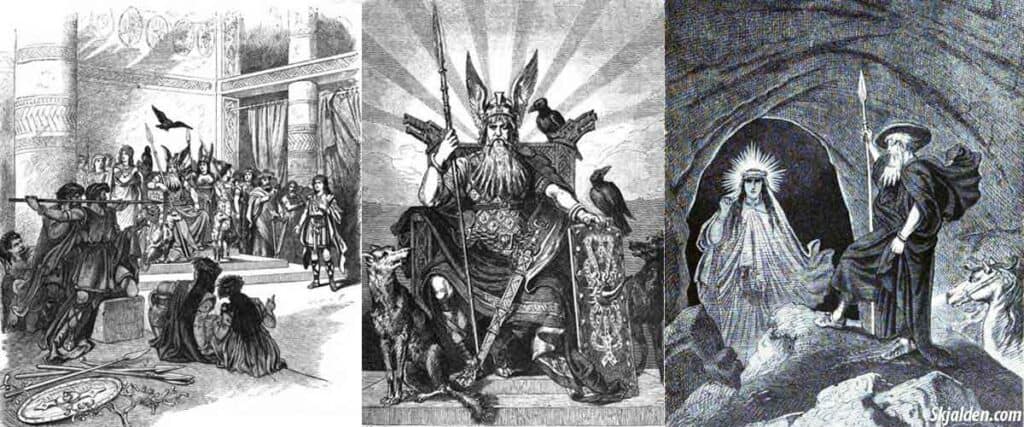
Two ravens, Huginn (“thought”) and Muninn (“memory,” or “mind”), and two wolves, Geri and Freki, both names meaning something like “greedy,” complete Odin’s household. They appear side by side in Grímnismál, where Odin says he needs no food — he lives on wine alone and feeds his own share to the wolves — and admits that he fears each day for Huginn, but fears even more for Muninn. Snorri adds that the ravens sit on Odin’s shoulders, fly out at daybreak, and return by breakfast time to tell him everything they have seen and heard, which is why he is called the raven-god.
Gungnir and Draupnir
Odin’s spear, Gungnir (“the swaying one”), never misses what it is thrown at, and runes are said to be carved on its point. It came to him through one of Loki’s pranks: after Loki cut off the hair of Thor’s wife, Sif, as a prank, he was forced to have the dwarves known as the Sons of Ivaldi forge her new hair of real gold — and the dwarves threw in two more gifts: the ship Skíðblaðnir and the spear Gungnir, which went to Odin.
To save his own neck afterward, Loki bet his head with the dwarf Brokkr that Brokkr’s brother Eitri could not forge anything to match the Sons of Ivaldi’s work. He lost: Brokkr and Eitri’s three gifts — the golden boar Gullinbursti, Thor’s hammer Mjölnir, and Odin’s ring Draupnir (“the dripper,” which drips eight new rings of equal weight every ninth night) — won the contest outright.
Loki then argued that he had bet his head but not his neck, so the dwarves could not cut without touching it — and they settled for sewing his lips shut instead. Draupnir’s story does not end with the wager, either. When Baldur died, Odin laid the ring on his son’s funeral pyre — and when Hermóðr rode to Hel to ask for Baldur back, Baldur sent Draupnir home with him as a keepsake for his father. The ring, as John Lindow puts it, has truly been to Hel and back.
Historical Worship: Was Odin Really Worshipped?
The clearest surviving description of real Odin worship comes not from a poem but from an 11th-century German churchman, Adam of Bremen, who wrote about a pagan temple at Uppsala, in Sweden. He describes three idols inside — Thor at the center, flanked by Wodan (Odin) and Fricco (Freyr) — and says the Swedes sacrificed to Thor against plague and famine, to Fricco at weddings, and to Wodan when war threatened.
Every nine years, he writes, a festival for all of Sweden was held there, lasting nine days. Nine males of every kind of living creature were sacrificed, humans included, and the bodies were hung in the sacred grove beside the temple — an unsettling real-world echo of Odin’s own nine nights on the tree.
A Christian told Adam he had seen 72 bodies hanging together. Nine victims on each of nine days would make 81, not 72, and scholars have argued over the gap ever since; the Swedish historian of religion Andreas Nordberg suggests nine victims on each of eight nights, with the ninth night as the moment the ritual took effect.
How much of this to trust is a genuinely open question. Adam never saw Uppsala himself: he gathered his information at the Danish court, and his informant was the Danish king Sven Estridsen, who had spent twelve years at the Swedish king’s side. Adam was also a Christian churchman with every reason to make pagan worship look as horrifying as possible.
The scholar Andy Orchard has called it unclear whether the account reflects “historical fact rather than lurid fiction,” and the historian Henrik Janson argues that Adam wrote it in the middle of the Investiture Controversy — the era’s power struggle between the Pope and the Holy Roman Emperor — so that the temple serves that conflict as much as it records Uppsala.
Lasse Sonne, writing in the National Museum of Denmark’s own anthology on the Viking Age, is blunter still: Viking-Age religion knew no temples with a professional priesthood, and Adam’s Uppsala temple has never been documented. Scholars now generally agree that worship took place in the halls of large farms, and Sonne notes that Odin’s cult in particular belonged to chieftains and the wealthy elite more than to ordinary farmers. Adam’s account is real, old, and worth knowing — it just is not proof, on its own, of exactly what happened at Uppsala.
A steadier kind of evidence survives in place names. The Danish city of Odense most likely takes its name from Old Norse Óðins vé, “Odin’s holy place” — a name people kept using for a thousand years after the god stopped being worshipped there. Snorri, in Ynglinga saga, even has Odin himself settle there, at a place he calls Óðinsey, “Odin’s island.”
Lindow notes that “Odin’s holy place” is the likelier meaning, but that it would not have suited Snorri’s story. Similar Odin-named places turn up across Denmark, Sweden, and Norway. Unlike Adam’s account, they do not depend on one distant chronicler. The names are still on the map. There is even older evidence from Denmark. A piece of human skull from 8th-century Ribe carries a runic inscription with Odin’s name. The archaeologist Else Roesdahl points out that his name was otherwise not used in personal names or called upon on rune stones.
Odin’s Fate at Ragnarök
For all his wisdom, Odin’s foresight cannot save him. In Völuspá, the seeress foretells that Odin will go out to fight the wolf Fenrir, and fall. Vafþrúðnismál and Snorri say plainly what happens: the wolf swallows him. His son Vidar avenges him at once — Völuspá has Vidar drive a sword into the wolf’s heart, Vafþrúðnismál has him split its jaws, and Snorri adds the famous detail of Vidar’s thick shoe, pinning the lower jaw while he tears the upper one apart.
Odin’s death is not a surprise to him. He sought out this exact prophecy himself — from Mímir, from the dead, from Vafthrúðnir — and has known it was coming ever since. When the world rises again after Ragnarök, Baldur and Höðr return, and Vidar and Vali survive. Odin does not.
Odin: Quick Answers
Why does Odin only have one eye? He left it in Mímir’s well as the price of a single drink of the wisdom hidden there. The seeress in Völuspá says she knows where Odin hid his eye — in Mímir’s famous well.
What are Odin’s ravens and wolves called? His ravens are Huginn (“thought”) and Muninn (“memory,” or “mind”); his wolves are Geri and Freki, both names meaning something like “greedy.”
How does Odin die in Norse mythology? At Ragnarök he goes out to fight the wolf Fenrir, and in Vafþrúðnismál and Snorri’s telling the wolf swallows him. His son Vidar avenges him immediately.
What did Odin whisper to Baldur? No one knows. In Vafþrúðnismál, Odin wins a contest of wisdom by asking the giant Vafthrúðnir exactly that — a question only Odin himself could answer — and no source ever reveals the words. The scholar John Lindow calls it the ultimate unknowable.
What is the Mead of Poetry? According to Snorri, a drink brewed from the blood of Kvasir, the wisest being ever made, that turns anyone who drinks it into a poet or a scholar. Odin stole it from the giant Suttung by seducing his daughter, Gunnlöd.
Did Odin create the world in Norse mythology? In Snorri’s Gylfaginning, yes — with his brothers Vili and Ve he killed the giant Ymir and built the world from his body. For the first humans, Ask and Embla, the older poem Völuspá names Odin, Hœnir, and Lóðurr as the gods who gave them life.
Why was Odin criticized for using magic? Loki mocks him in Lokasenna for practicing seiðr, a form of magic linked to women. Snorri says it was considered shameful for men — Odin practiced it regardless.
Where does Sleipnir come from? Loki, shape-shifted into a mare, lured away the stallion of the builder raising Asgard’s wall, and later gave birth to Sleipnir, the eight-legged horse that became Odin’s.
Sources:
Jesse Byock (2005) Snorri Sturluson, The Prose Edda. 1st edition. London, England: Penguin Books Ltd. ISBN-13 978-0-140-44755-2 — source for the Mead of Poetry, the forging of Draupnir and Gungnir, and Odin’s genealogy.
Lee M. Hollander (1962) The Poetic Edda. 15th edition. Texas, USA: University Research Institute of the University of Texas. ISBN 978-0-292-76499-6 — includes Grímnismál, Vafþrúðnismál, Völuspá, Baldrs draumar, and Lokasenna, source for Odin’s names, the wisdom contest, his fate at Ragnarök, the seeress he wakes from her grave, and Loki’s taunt about seiðr.
Lee M. Hollander (1964) Heimskringla: History of the Kings of Norway. Texas, USA: University of Texas Press. ISBN-13 978-0-292-73061-8 — a separate translation from his Poetic Edda above; covers Ynglinga saga, Snorri’s account of Odin as a human chieftain, his powers, and Freya teaching the Aesir seiðr.
Dr. Jackson Crawford (2019) The Wanderer’s Hávamál. Indianapolis, USA: Hackett Publishing Company. ISBN-13 978-1-6246-6835-7 — a translation of Hávamál built specifically around Odin’s own words and wisdom, source for the hanging on the tree and the eighteen charms.
John Lindow (2002) Norse Mythology: A Guide to the Gods, Heroes, Rituals, and Beliefs. Oxford, England: Oxford University Press. ISBN-13 978-0-195-15382-8 — source for Odin’s more than 150 names, the differences between Snorri and the older poems, and the Odense place name.
Adam of Bremen, trans. Francis J. Tschan (1959, repr. 2002) History of the Archbishops of Hamburg-Bremen. New York, USA: Columbia University Press. ISBN-13 978-0-231-12574-1 — the primary 11th-century source for the Uppsala temple account, including the “Wodan, id est furor” etymology.
Andreas Nordberg (2006) Jul, disting och förkyrklig tideräkning. Uppsala, Sweden: Kungl. Gustav Adolfs Akademien för svensk folkkultur. ISBN 91-85352-62-4 — Swedish-language study; source for Adam of Bremen’s Danish informant and the 72 victims at Uppsala.
Vinkler på vikingetiden (2013). Nationalmuseet and Skoletjenesten. ISBN 978-87-404-4484-1 — the National Museum of Denmark’s anthology; chapters by Lasse Sonne (no Viking-Age temples, Odin’s elite cult) and Jens Peter Schjødt (the spear thrown over the enemy army).
Andy Orchard (1997) Dictionary of Norse Myth and Legend. London, England: Cassell. ISBN-13 978-0-304-35134-3 — source for the “historical fact rather than lurid fiction” assessment of Adam of Bremen’s account.
Henrik Janson (1998) Templum nobilissimum: Adam av Bremen, Uppsalatemplet och konfliktlinjerna i Europa kring år 1075 (PhD dissertation, University of Gothenburg) — an untranslated Swedish-language academic dissertation, no consumer edition available; source for the Investiture Controversy reading of Adam’s Uppsala account.
Else Roesdahl (1998) The Vikings. Revised edition. London, England: Penguin Books. ISBN-13 978-0-140-25282-8 — source for the Ribe skull inscription naming Odin.