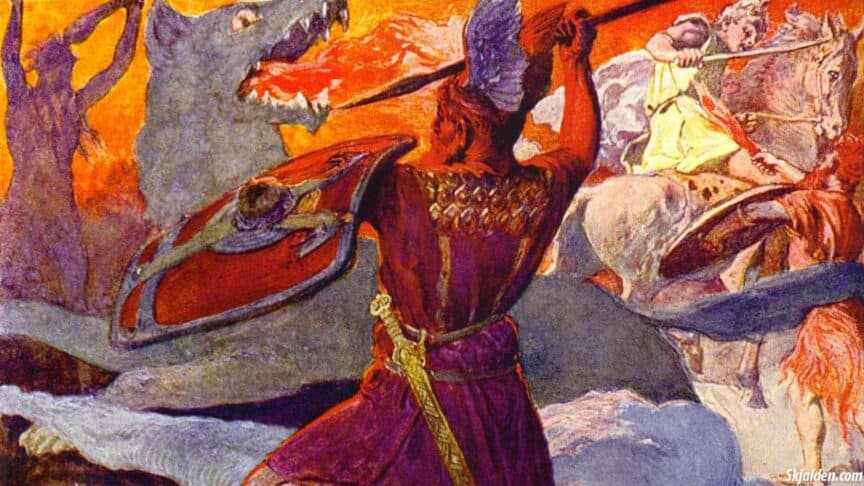
Ragnarok is the end of the world in Norse mythology, and the day the gods themselves die. The Vikings believed it would come at some unknown time in the future. The gods and the giants would fight one final battle, on a battlefield called Vigrid. Not even the sun, the sky, or the world itself would survive it. The main sources for the story are Snorri Sturluson’s Gylfaginning (ch. 51–53) and the poems Völuspá and Vafþrúðnismál.
As the battle begins, the Midgard Serpent rises from the sea, spraying poison and sending huge waves crashing onto the land. The rainbow bridge Bifrost breaks as the fire giants, led by Surtr, ride over it toward Asgard. Fenrir breaks free of his chains, and even the world tree Yggdrasil shakes down to its roots.
The Signs of Ragnarok in Norse Mythology
A few signs are said to warn that Ragnarok is coming:
- The death of the god Baldur, son of Odin and Frigg, told in Snorri’s Gylfaginning.
- Fimbulwinter: three brutal winters in a row, with no summer between them. Food runs out, and people turn on each other. Völuspá says that even brothers will kill each other before the end.
- The wolves finally swallow the sun and the moon, plunging the world into darkness even before the fighting starts.
How Does Ragnarok Begin?
According to Völuspá (stanzas 42–43), three roosters crow to announce that the battle has begun: Fjalar, crowing to the giants in the forest Gálgviðr; Gullinkambi (“Golden Comb”), crowing to the gods in Asgard; and a third, unnamed soot-red rooster, crowing in Hel.
Heimdall blows his horn, the Gjallarhorn, calling every einherji to arms. Einherjar are the warriors who died bravely in battle and were brought to Valhalla or Folkvangr — now they arm themselves for one final fight. Before riding out, Odin seeks one last counsel from Mímir — Völuspá (stanza 46) has his severed head speak, while Gylfaginning (ch. 51) has Odin ride to Mímir’s well instead. Then he mounts Sleipnir, spear in hand, and leads the army of Asgard to Vigrid.
The giants sail to the battle on the ship Naglfar, built from the uncut nails of the dead. The sources do not agree on who steers it. In Völuspá, Loki is at the helm. In Snorri’s own telling, a giant named Hrym steers Naglfar, while Loki comes with all the people of Hel.
Who Dies at Ragnarok?
Odin fights Fenrir, and the wolf swallows him. His son Vidar avenges him immediately after — though the sources describe it two different ways. In Gylfaginning, Vidar steps on Fenrir’s lower jaw with a specially made shoe and tears the wolf’s jaws apart with his bare hands. In Völuspá, he simply drives a sword through the wolf’s heart. Snorri actually quotes the Völuspá version right after telling his own, without picking one over the other — so neither is more “official” than the other.
Loki and Heimdall kill each other, finally ending Loki’s long betrayal — though it costs the gods their guardian. Tyr fights Garmr, the hound associated with the cave Gnipahellir — and neither one walks away from it.
Thor finally gets his rematch with the Midgard Serpent. He kills it with his hammer, but the serpent has already covered him in venom — Snorri says Thor manages nine more steps before collapsing dead himself.
Freyr fights Surtr, and loses. The reason is a story of its own: years earlier, Freyr gave away his own magic sword to his servant Skírnir, as payment for helping him win the giantess Gerd. At Ragnarok, Freyr has to face Surtr and his blazing sword without it. Snorri says that this is when Freyr will miss the sword he gave away. Some retellings go further, suggesting the sword that kills him is the very one he gave away. The sources don’t confirm that detail directly, but it’s a popular reading precisely because of how fitting it would be.
Does the World End for Good?
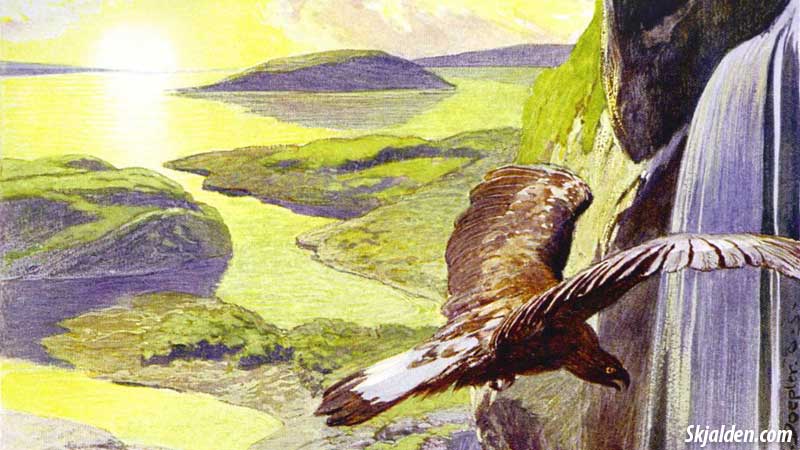
This is genuinely disputed, not just a matter of which version you prefer. Some scholars see Ragnarok as the true, final end, where nothing survives, and nothing comes after. The sources that tell the story, however, describe a rebirth: a new, green earth rising from the sea, a new sun, and a small number of survivors starting over.
Scholars are divided on which version is older. Norse mythology writer Daniel McCoy argues, in his book The Viking Spirit, that the no-rebirth ending is the original, more purely pagan belief. In his view, the rebirth was added later, under Christian influence, once the Viking world had already begun converting.
More broadly, historians agree that parts of Völuspá show signs of being reworked by Christian-era scribes — and Völuspá is where most of the rebirth imagery comes from. Lee M. Hollander, who translated the Poetic Edda, thought the poem’s golden hall Gimlé looks like a reflection of the heavenly Jerusalem in the Bible.
But the rebirth is not only found in Völuspá. In Vafþrúðnismál, two humans also survive, and the sun has a daughter who takes over her mother’s path after the wolf has swallowed her. Exactly how much of it was changed is still an open, actively debated question.
The rebirth version is the one most commonly retold today, including on this page — but it’s worth knowing that some scholars think it was not part of the oldest belief.
What Happens After Ragnarok?
In the version with a rebirth, two people survive: Líf (“Life”) and Lífþrasir (“Striving After Life”). They hide in a place called Hoddmímis holt, the “Wood of Hoddmimir” — sometimes understood as another name for Yggdrasil itself, though the sources aren’t fully clear on that. Once the battle ends, they come out and repopulate the new earth.
Several gods survive too: Odin’s sons Vidar and Vali, the god Hœnir, and Thor’s sons Modi and Magni, who inherit their father’s hammer Mjölnir. Baldur and Höðr also come back from Hel and live together in the new world. The surviving gods settle at Idavoll, where Asgard used to stand. The finest hall in the new world is Gimlé, roofed with gold.
There is also Brimir, a hall with plenty of good drink at a place called Okolnir, “Never Cold,” and Sindri, a hall of red gold in the mountains of Nidafjoll.
Not everywhere is peaceful, though. Náströnd, the “Corpse-shore,” is a hall reserved for oath-breakers, murderers, and adulterers. Its walls are woven from snakes that drip venom into the hall below. Nidhogg is there too, still feeding on the dead — some things, apparently, don’t end even when the world does.
Ragnarok: Quick Answers
What does Ragnarok mean in Norse mythology? It comes from Old Norse Ragnarök, “fate of the gods,” the form most of the poems use. Snorri Sturluson himself writes Ragnarøkkr, “twilight of the gods,” and that is where the popular “Twilight of the Gods” translation comes from.
Who kills who at Ragnarok? Odin is swallowed by Fenrir, then avenged by his son Vidar. Thor kills the Midgard Serpent but dies from its venom. Tyr and Garmr kill each other, as do Loki and Heimdall. Freyr is killed by Surtr, having lost his own magic sword years earlier.
Does anyone survive Ragnarok? Yes — several gods, including Vidar, Vali, Baldur, and Höðr, along with two humans, Líf and Lífþrasir, who repopulate the new earth that rises afterward.
Is the rebirth part of the myth original, or added later? That’s genuinely disputed. Völuspá, Vafþrúðnismál and Snorri all describe a new world after the battle. Whether that rebirth reflects real pre-Christian belief or was added under later Christian influence is an open question among scholars.
Sources: