In Norse mythology, Hel is the ruler of the underworld that bears her name — Hel, often called Helheim in modern English. According to Snorri Sturluson’s Gylfaginning, Odin cast her into Niflheim and gave her authority over nine worlds, to assign dwellings (places to live) to those sent to her. Those dwellings were for people who die of illness or old age, rather than gloriously in battle.
That does not mean everyone who died outside of combat went to Hel. The surviving sources describe more than one possible destination for the dead, and Viking Age beliefs were likely more varied than a simple Valhalla-or-Hel contrast suggests.
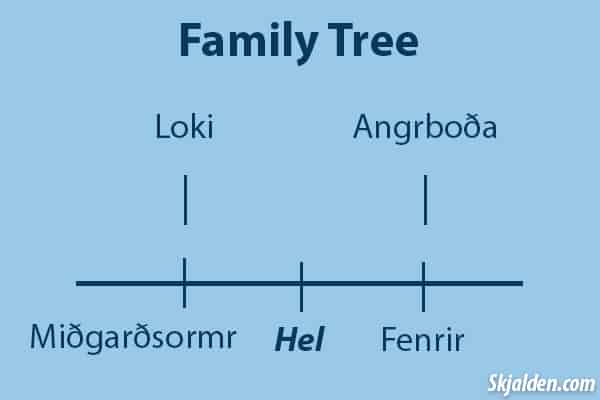
Hel is the daughter of the trickster Loki and the giantess Angrboda. Her siblings are the world serpent Jörmungandr and the Fenrir Wolf — Snorri writes that Odin judged all three children dangerous and had them sent away from the gods. Their surviving myths take them in very different directions from there: Jörmungandr is cast into the sea, Fenrir is bound by the gods, and Hel is sent to Niflheim to rule over the dead.
Is Hel a Goddess?
It’s a common misconception that Hel is the goddess of death. The surviving Eddic sources do not call her a goddess or an ásynja — the term reserved for female members of the Aesir like Frigg or Freya. Instead, they introduce her plainly as Loki’s daughter, the ruler Odin gave authority over the dead.
Whether Hel was ever actually worshipped as a goddess, before any of this was written down, is a separate and genuinely open scholarly question. Rudolf Simek has written bluntly that “nothing speaks in favor of there being a belief in a goddess Hel in pre-Christian times,” and John Lindow has argued much the same. Hilda Ellis Davidson took a similar view in her 1968 study The Road to Hel — but later reconsidered, comparing Hel to the ancient Irish battle-goddesses Badb and the Morrígan. No confirmed inscriptions, cult sites, or offerings tied to a goddess Hel are known, so the evidence is limited either way.
For what it’s worth, Loki’s own status is similarly blurry. His father is the jötunn (giant) Fárbauti, and his mother is Laufey — she’s listed among the ásynjur (the female Aesir) in a later poetic catalogue, though her exact status is debated too. Hel, though, has no comparable status among the gods in any surviving source.
What Does Hel Look Like?
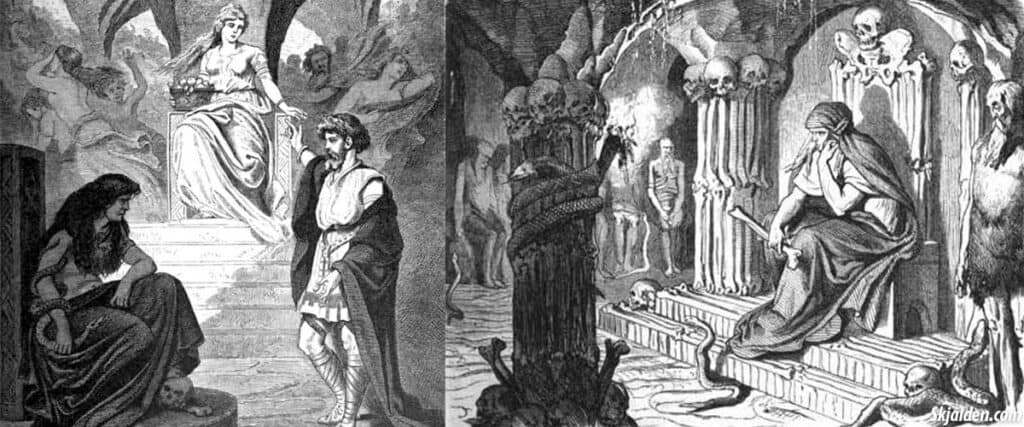
Snorri describes Hel in Gylfaginning (ch. 34) as half the color of a living person’s skin and half blue or dark in color — “því er hon auðkennd,” by this she is easy to recognize. He also calls her “gnúpleit ok grimmlig”: gloomy and fierce.
The Old Norse word Hel, which in Old English is Hell, derives from the reconstructed Proto-Indo-European root *kel-. Therefore, both of the words can be translated into “hide” or “cover” in modern English.
How Did Hel Become Ruler of Helheim?
According to Gylfaginning (ch. 34), Odin, chief of the Aesir, cast Hel into Niflheim and gave her authority over nine worlds, to assign dwellings to those sent to her. Snorri plainly names her ruler of that realm — the underworld became hers to govern, though nothing suggests she claimed the title for herself.
What Are the Gates of Helheim Like?
The sources don’t add up to one complete map of Hel’s realm. Snorri says her courts (the walled grounds around her hall) are exceptionally high and her gates great — the gates themselves are called Corpse-gates, Old Norse Nágrindr.
Snorri says so directly: in his list of the eleven rivers of Élivágar, he names Gjöll as the one that runs “hard by Hel-gates.” It’s the same river Hermód later crosses, on the bridge Gjallarbrú, in the story of Baldur’s death.
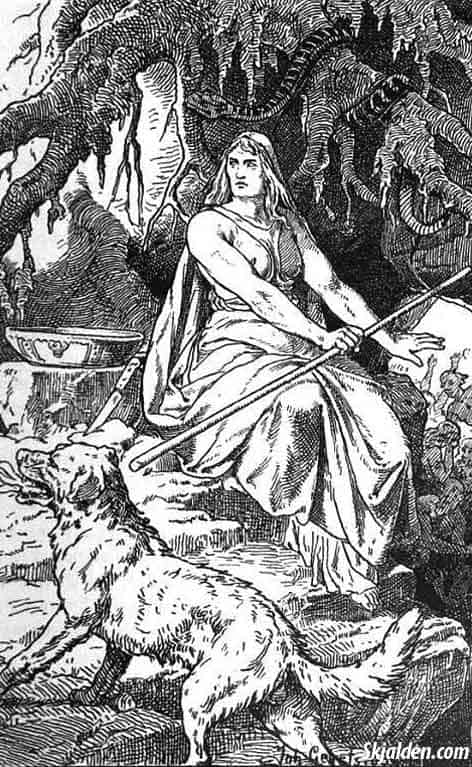
Völuspá repeatedly describes the hound Garmr baying before the cave Gnipahellir. Garmr is sometimes called a “hellhound” in modern retellings, and according to Jackson Crawford’s translation of the Poetic Edda, some scholars have also connected him with Fenrir, since both are described as bound and both break free at Ragnarök — but the texts don’t explicitly identify them as the same being.
The dragon Nidhogg (Old Norse: Níðhöggr) gnaws at one of Yggdrasil‘s roots, according to Snorri. Völuspá also describes a grim place called Náströnd, the “Corpse-shore,” where Nidhogg sucks the corpses of the dead while a wolf tears at the bodies of men. The poem links Náströnd to oath-breakers, murderers, and adulterers, but doesn’t clearly say how it relates to Hel’s own realm.
Hel’s Role at Ragnarök
Snorri is less specific about Hel’s own role at Ragnarök than modern retellings often suggest. Gylfaginning says only that “all Hel’s people” march among Loki’s forces at the final battle. Naglfar, the ship built from the uncut nails of the dead, carries hostile forces toward Vigrid alongside them. Snorri even warns that anyone dying with untrimmed nails contributes material to the ship — so it was worth taking care to trim a corpse’s nails. Naglfar appears in just two stanzas of the Poetic Edda’s Völuspá, and again in Gylfaginning (ch. 43 and 51). The sources don’t agree on exactly who steers it, though, so it’s safest not to say Hel personally commands the ship.
Hel’s Hall of Misfortune
Hel’s hall is called Éljúðnir, meaning “sprayed with snowstorms” — and per Gylfaginning (ch. 34), everything inside it is named for misfortune. Her dish is called Hungr (Hunger) and her knife Sultr (Famine); her bed is Kör, meaning sick-bed, hung with curtains called Blikjandaböl, “Gleaming-bale.” Even her servants carry the theme — the manservant Ganglati and the maidservant Ganglöt both mean roughly “the slow one” — and the threshold into the hall is a pitfall called Fallandaforað, “peril of falling.”
Hel in the Death of Baldur
The best-known myth featuring Hel is the story of the death of Baldur, told in Snorri’s Gylfaginning (ch. 49). In it, Hermód the brave volunteered to ride down into the darkness for nine nights on Sleipnir to bring Baldur back from the dead. When he came to the same river Gjöll described above, he had to cross the gold-roofed Gjöll Bridge into Helheim.
This is not the only Old Norse poem set in Hel’s realm. In the Poetic Edda poem Baldrs draumar, Odin himself rides down to Niflhel to wake a dead völva and question her about the troubling dreams that warned of Baldur’s coming death. The poem describes a hound Odin passes along the way, “bloody… on his breast before,” but the poem never actually names the animal as Garmr. Where that identification is made, it’s an inference by later readers, not a claim the text itself makes.
But he was stopped by the maiden Móðguðr (also written Modgud) who demanded that he explain what he wanted before he was allowed to pass. When he met Hel in her realm, she would only agree to let Baldur return with him, if every last thing in the universe would weep for him.
Everything did weep except a giantess named Þökk — no matter what the Aesir did, she refused to shed a single tear for him. It is believed that this was Loki in a disguise, and another one of his tricks to ruin everything for the Aesir. Because of this, the Aesir failed to get him back from the dead. In Snorri’s telling, Baldur remains in Hel — though the poem Völuspá describes him returning, alongside Höðr, in the renewed world after Ragnarök.
Is Helheim the Same as the Christian Hell?
Hel is not simply the Norse equivalent of the Christian hell. When Hermód reached Baldur in Hel’s hall, Gylfaginning describes him seated in the foremost seat — not suffering, but honored. At the same time, Völuspá contains Náströnd, a grim hall in the underworld reserved for serious wrongdoers. The exact relationship between Náströnd, Hel, Niflhel, and the other Norse realms of the dead isn’t fully clear in the surviving texts. So it would be overstating the evidence to say Hel’s own realm held both fates directly.
How Reliable Are These Accounts?
What the people during the Viking Age really thought of Hel has mostly been lost, and even Snorri Sturluson‘s descriptions of her have most likely been influenced by his own Christian faith.
Hel: Quick Answers
Is Hel a goddess? No — the Eddic sources never call her a goddess or an ásynja. They introduce her as Loki’s daughter and as the ruler Odin gave authority over the dead. Whether she was ever actually worshipped as a goddess before Christianity is a separate, still-open scholarly question.
What does Hel rule over? Hel rules the underworld that bears her name, often called Helheim. Odin sent her people who die of illness or old age — not simply everyone who doesn’t die in battle.
Who are Hel’s parents and siblings? Hel is the daughter of Loki and the giantess Angrboda. Her siblings are the wolf Fenrir and the world serpent Jörmungandr.
What does Hel look like? Snorri describes her as half the color of a living person’s skin and half blue or dark — “easy to recognize” — and gloomy and fierce in expression.
Is Helheim the same as the Christian Hell? No. Baldur is shown seated in the place of honor in Hel’s hall, not tortured — though Norse texts do describe a separate grim place, Náströnd, reserved for serious wrongdoers.
Sources: