In Norse mythology, Angrboda (Old Norse: Angrboða) is a jötunn, a giantess, and the mother of Loki’s three monstrous children: the Fenrir wolf, the world serpent Jörmungandr, and Hel, the ruler of the dead. The name Angrboda means “the one who brings grief” or “she who offers sorrow”.
Very little is written about Angrboda herself, yet few figures in the mythology leave a bigger mark. Two of her children kill two of the greatest gods at Ragnarök, and the third rules over everyone who dies of sickness or old age. Much of the end of the world grows out of her family.
Who Is Angrboda?
Angrboda is named only once in the old poems. In Hyndluljóð, stanza 40, the poet says that “Loki sired the wolf on Angrboda”. That short line is all the poetry gives us about her by name.
Most of what we know comes from the first part of the Prose Edda by Snorri Sturluson, known as Gylfaginning or The Beguiling of Gylfi. Snorri calls her “a giantess in Jötunheimar”, the land of the giants, and he names her three children with Loki. Angrboda’s children are quite literally monsters, and none of them is even remotely similar to the others.
The Old Woman in the Iron Wood
It is often said that Angrboda lives alone in Jötunheim and has no contact with Loki or their children. The sources point in a different direction. Snorri says that the gods learned the children “were being raised in Jötunheimar”, which suggests they grew up in the land of the giants, not far from their mother.
The poem Völuspá adds a mysterious figure. In stanza 40 it says:
To the east sat the old lady in Járnvid
And raised there the kinfolk of Fenrir.
Járnviðr, the Iron Wood, is a forest east of Midgard where giantesses live. “The kinfolk of Fenrir” means wolves, and the same stanza goes on to say that one of these wolves will one day swallow the sun.
Snorri explains the stanza by saying that an old giantess in the Iron Wood gives birth to many giants in the form of wolves. The poem never names her, but the scholar John Lindow calls her “almost certainly Angrboda”.
Lee M. Hollander and Jesse Byock, who both translated the Eddas, are a little more careful and call her “probably” or “perhaps” Angrboda. If he is right, Angrboda is not a mother who was cut out of her children’s lives. She is the old woman in the forest who raises the wolves of the end of the world.
Angrboda’s Three Children
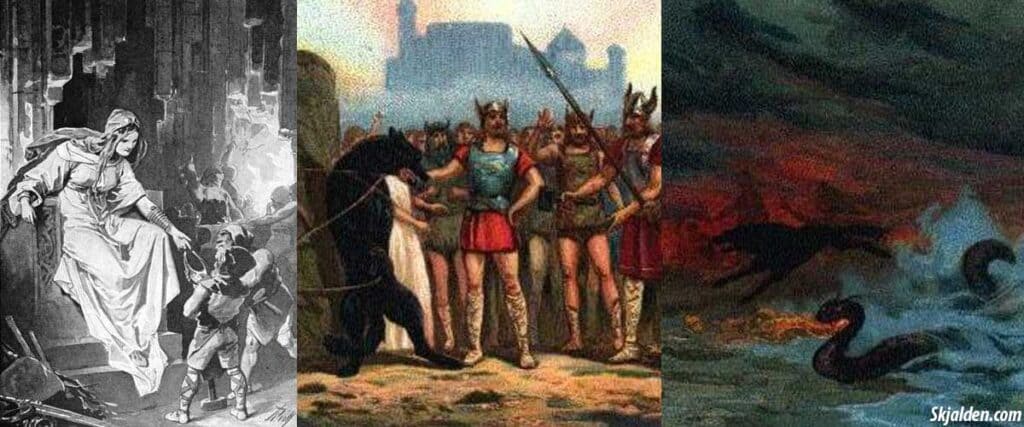
When the gods found out what Loki and Angrboda had brought into the world, they were worried. Snorri says they learned through prophecy that the three children would bring great trouble to the gods, so Odin had them brought to him.
Odin threw Jörmungandr into the sea. There the serpent grew so large that it now lies around the whole world and bites its own tail, which is why it is also called the Midgard Serpent. Hel was sent down to the world of the dead, where she was given power over everyone who dies of sickness or old age.
Fenrir was kept by the gods in Asgard, but only Tyr was brave enough to feed him. When the gods saw how quickly the wolf was growing, they decided to bind him.
How the Gods Bound Fenrir
The gods first tried a strong chain called Læðingr, but Fenrir broke it with ease. The second chain, Drómi, was even stronger, and he broke that one too. So Odin sent Skírnir, the servant of Freyr, to the dwarves to make something stronger.
The dwarves made a fetter called Gleipnir. It looked as thin and soft as a silk ribbon, but it was made from six things that no longer exist: the sound of a cat’s footsteps, a woman’s beard, the roots of a mountain, the sinews of a bear, the breath of a fish and the spit of a bird.
Fenrir did not trust a ribbon that looked so harmless. He agreed to be bound only if one of the gods placed a hand in his mouth as a promise that it was not a trick. Tyr was the only one who dared. When Fenrir found that he could not break free, he bit off Tyr’s hand. The wolf was left bound on the island of Lyngvi, where he will stay until Ragnarök.
Angrboda and Ragnarök
Angrboda herself does not appear at Ragnarök, but her children are at the heart of it. Fenrir breaks free and kills Odin, and Jörmungandr and Thor kill each other.
That is why Angrboda matters so much, even though the sources say so little about her. Loki fights on the side of the giants at the end, but the monsters that end the world were born to Angrboda.
Frequently Asked Questions About Angrboda
Who Is Angrboda in Norse Mythology?
Angrboda is a giantess (jötunn) and the mother of Loki’s three monstrous children: the wolf Fenrir, the world serpent Jörmungandr and Hel, the ruler of the dead.
What does the name Angrboda mean?
Angrboda means “she who offers sorrow” or “the one who brings grief”. It comes from the Old Norse word angr, meaning grief or sorrow.
Did Angrboda raise her children?
Possibly. Snorri says the children were raised in the land of the giants, and Völuspá tells of an old woman in the Iron Wood who raises “the kinfolk of Fenrir”. Many scholars, including John Lindow, think that woman is Angrboda.
Who are Angrboda’s children?
Angrboda and Loki have three children: Fenrir, Jörmungandr and Hel. Snorri tells how the gods threw Jörmungandr into the sea, sent Hel to the world of the dead and bound Fenrir with the fetter Gleipnir.
What is Angrboda’s connection to Ragnarök?
Her children play a central part in it. Fenrir kills Odin, and Jörmungandr and Thor kill each other.
Sources
- Hyndluljóð, stanza 40, and Völuspá, stanza 40, Poetic Edda. Quoted in the translation of John Lindow.
- Snorri Sturluson, Gylfaginning in the Prose Edda (c. 1220): the Iron Wood, Loki’s children and the binding of Fenrir.
- John Lindow, Norse Mythology: A Guide to the Gods, Heroes, Rituals, and Beliefs (Oxford University Press, 2001), “Angrboda”, p. 59, “Fenrir”, and “Járnvid”, p. 204.
- Jesse Byock (2005) Snorri Sturluson, The Prose Edda. London: Penguin Books. ISBN 978-0-140-44755-2
- Anthony Faulkes (1995) Snorri Sturluson, Edda. London: Everyman J. M. Dent. ISBN 978-0-4608-7616-2
- Lee M. Hollander (1962) The Poetic Edda. Austin: University of Texas Press. ISBN 978-0-292-76499-6