
Freya (Old Norse Freyja, “Lady”) is the goddess of love, beauty, and fertility in Norse mythology — and, less commonly remembered, of sorcery, gold, and death as well. Her name is also spelled Freyja, Freja, Fröja, or Frøya.
Freya is not one of the Aesir by birth. She belongs to the Vanir, an older branch of gods who lived in the realm of Vanaheim, and was sent to live among the Aesir in Asgard as part of a truce after a war between the two groups — Snorri Sturluson names her, alongside her father Njörð and brother Freyr, as hostages exchanged to end the fighting (Gylfaginning ch. 23; told again, with more detail on the war itself, in Snorri’s Ynglinga saga, ch. 4).
She became an honored member of the Aesir afterward, and Snorri calls her, in the very next chapter, the most renowned of the Ásynjur, the female Aesir (Gylfaginning ch. 24) — a status high enough that her importance is arguably on par with Odin’s own.
Who Is Freya in Norse Mythology?
Freya is the daughter of Njörð, who lives by the sea in his hall Nóatún. Her mother is unknown — possibly a sister of Njörð, since marriage between siblings is described elsewhere as a Vanir custom, but no source confirms this directly. Her twin brother is Freyr, who lives in Alfheim, a realm given to him by the Aesir.
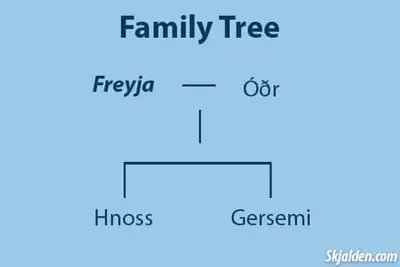
Freya is the daughter of Njörð, who lives by the sea in his hall Nóatún. Her mother is unknown — possibly a sister of Njörð, since marriage between siblings is described elsewhere as a Vanir custom, but no source confirms this directly. Her twin brother is Freyr, who lives in Alfheim, a realm given to him by the Aesir.
What Does Freya Rule, and What Magic Does She Practice?
Freya, not Odin, has first pick of the warriors who die in battle. She takes half of them to her own hall, Sessrúmnir, on the field of Fólkvangr; the rest go to Valhalla. Some scholars have proposed in recent years that Fólkvangr and Valhalla might be two names for the same place — the sources are thin enough that it’s a real, open question, not a settled one.
Freya was also the one who taught seiðr, a form of Norse magic and prophecy, to Odin and the rest of the Aesir — before her, it was practiced only among the Vanir. She and her father are named as the gods’ high priest and priestess of sacrificial offerings (Snorri Sturluson, Ynglinga saga, ch. 4).

How Does Freya Travel Between the Realms?
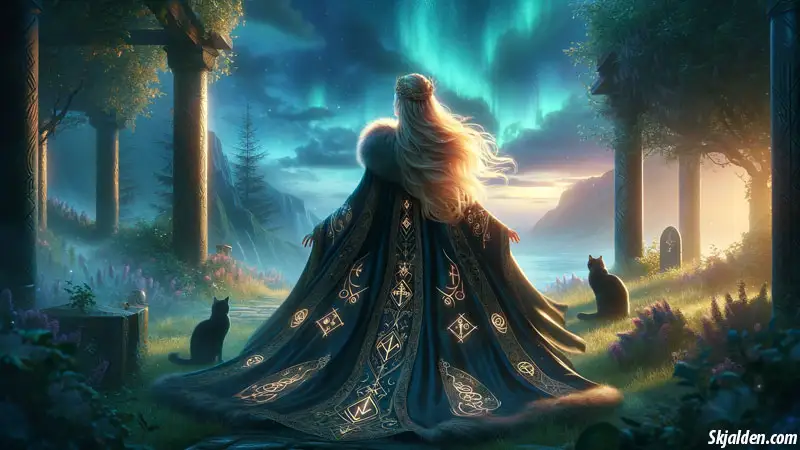
Freya has several ways of traveling between the realms. The most famous is her chariot, pulled by two cats. She also owns a cloak of falcon feathers that lets her fly anonymously and observe the world below — a cloak she willingly lends to other gods and goddesses when they need to travel quickly. It was this cloak that Loki borrowed to rescue the goddess Idunn from Jötunheim, fleeing the eagle Thiazi on the way back — ironic, since Loki was the one who’d arranged for her to be kidnapped in the first place.
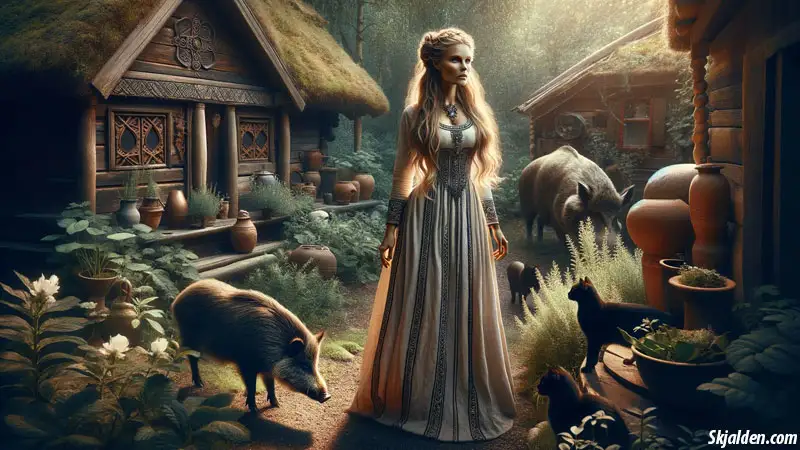
Her third option is her boar, Hildisvíni (“battle swine”). In the poem Hyndluljóð, the giantess Hyndla accuses Freya of bringing her lover along in disguise (st. 6) — Freya insists it’s simply her golden-bristled boar (st. 7). That boar is Óttar himself — Freya rides him to reach the giantess Hyndla, so that Hyndla can be persuaded to recite his ancestry and settle a wager over his inheritance (st. 8–9). Loki, elsewhere, calls the whole arrangement exactly what it looks like: Óttar in disguise as her lover.
At Ægir’s feast, in the poem Lokasenna, Loki accuses Freya of having slept with every god and elf in the hall (st. 30). She fires back that his lies will cost him (st. 31) — so Loki escalates, naming her own brother Freyr specifically and calling her the “foulest witch” (st. 32). Her father Njörð cuts in, but his defense is half-hearted: he waves off the accusation as no real shame for a woman to take lovers, then turns straight to mocking Loki instead — for having once shape-shifted into a mare and given birth (st. 33), the same jibe Odin had already made earlier in the poem (st. 23)
Why Was Freya So Desired?
Freya’s beauty draws admirers among gods, elves, dwarves, and jötnar alike. When an unnamed builder offered to raise walls around Asgard too strong for any giant to breach, his price was Freya’s hand in marriage. In the Skáldskaparmál (ch. 17), a drunken Hrungnir boasts that he’ll lift Valhalla and carry it off to Jötunheim, sink Asgard, and kill every god except Freya and Sif — whom he’d take home with him instead.
Freya loves fine jewelry, and one of her most prized possessions, the necklace Brísingamen (roughly “fiery necklace”), came at a real cost. According to Sörla þáttr — a short tale preserved in the 14th-century Flateyjarbók manuscript — she found four dwarves, Alfrigg, Dvalinn, Berling, and Grer, in a cave nearly finished crafting it. She offered gold and silver for it, but they wanted only one thing: a night with each of them. She agreed, and the necklace was hers.
“Innocent” is not a word that fits Freya well — she’s closer to the party girl of the Aesir than a chaste ideal. Her connection to fertility isn’t about agriculture, but about sex and childbearing; she’s best understood as the female counterpart to Freyr’s fertility role.
What Real Traces of Freya Survive Today?
Freya’s popularity in Viking Age Scandinavia shows up in real places and objects. Many Norwegian farms carry names built on “Frøy,” e.g. Frøyland, and farms named Frøyjuhof (“Freya’s temple”) survive in Hole and Stjørdal. The same pattern shows up across Scandinavia — Frølund and Frøbjerg in Denmark, Frölunda and Frötuna in Sweden.
During Scandinavia’s conversion to Christianity, plant names tied to Freya were often replaced — common milkwort (Polygala vulgaris), once called “Freya’s hair,” was renamed for the Virgin Mary instead. Archaeology backs this up too: a silver figure believed to depict Freya was found at Tissø in Denmark, and an amulet at Aska, Hagebyhöga in Sweden.
Denmark’s national anthem, “Der er et yndigt land,” even calls the country “Freya’s hall” (Frejas sal) in its closing lines:
There is a lovely country
it stands with broad beech-trees,
near the salty eastern shore
It bends itself in hill, valley,
its name is old Denmark
and it is the hall of Freya.
Der er et yndigt land,
det står med brede bøge
nær salten østerstrand.
Det bugter sig i bakke, dal,
det hedder gamle Danmark
og det er Frejas sal.
Freya and Frigg: Are They the Same Goddess?
Freya and Frigg share real similarities: both are credited in different sources with having the weekday Friday named after them, and both have been proposed as the origin of the same underlying figure. If you ask a native English speaker, they’ll probably say the day is named after Frigg; ask someone from Scandinavia, and they’ll say it’s after Freya. This is likely because in English, “Friday” resembles “Frigg,” while in Danish, Norwegian, and Swedish, the day is spelled “Fredag” — closer to “Freya.” Adding to the confusion, Norse sources mention both Freyjadagr (Freya’s day) and Frjádagr (Frigg’s day) directly.
The scholar Stephan Grundy examined this question directly in a dedicated study, and his conclusion is careful, not confident: “the problem of whether Frigg or Freyja may have been a single goddess originally is a difficult one,” made harder by how little pre-Viking Age evidence about Germanic goddesses survives at all. A real asymmetry works against a clean answer: among the Proto-Germanic peoples, Frigg (Frijjō) is attested as a fertility goddess across the whole Germanic-speaking world — Old English Frīg, Old High German Frīja, and Friday is still Freitag in German today.
There doesn’t seem to be a goddess or similar figure by the name Freya anywhere in continental Germanic mythology; she appears to be exclusively Scandinavian. Most linguists don’t accept a shared origin for the two names on linguistic grounds alone — their meanings aren’t even related (Frigg means “beloved,” Freya means “Lady”). During the Viking Age, in fact, a woman who managed her own household was herself called a “Freyja” — the lady of the house.
Freya and Frigg cross paths again later in that same poem, Lokasenna, at Ægir’s feast. Loki accuses Frigg of taking her husband’s own brothers, Vili and Ve, as lovers (st. 26) — Frigg fires back with a threat of her own (st. 27). A few stanzas later, after Loki boasts about having caused Baldur’s death, it’s Freya who cuts in, calling him mad for admitting it and noting that Frigg already knows the fate of everyone, even when she doesn’t say so herself (st. 29).
One detail that keeps the question alive: Freya’s husband Óðr and Frigg’s husband Odin have names that mean essentially the same thing (furor, frenzy, inspiration), and Odin’s own long absences from Asgard echo Óðr’s disappearances from Freya. It’s a real, interesting parallel — but a parallel isn’t proof, and the surviving Old Norse sources consistently treat Freya and Frigg as two distinct goddesses, whatever their deeper history might be.
Freya: Quick Answers
Is Freya an Aesir or a Vanir? Freya is Vanir by birth, sent to live among the Aesir as part of a truce after the Aesir-Vanir War. Snorri calls her an honored member of the Aesir afterward, and the most renowned of the Ásynjur.
Are Freya and Frigg the same goddess? It’s a genuinely open scholarly question, not a settled one. Real similarities exist, but the surviving Norse texts always treat them as two separate goddesses, and the scholar most directly focused on the question (Stephan Grundy) concludes it’s simply not possible to say for certain either way.
Is Fólkvangr the same as Valhalla? Possibly — some scholars have proposed they’re two names for the same hall, since Freya takes half the battle-dead there and Odin takes the rest to Valhalla. The sources don’t settle it either way.
What is Freya the goddess of? Love, beauty, fertility, sorcery (seiðr), gold, war, and death — a wider range than the “love goddess” label usually implies.
Sources: