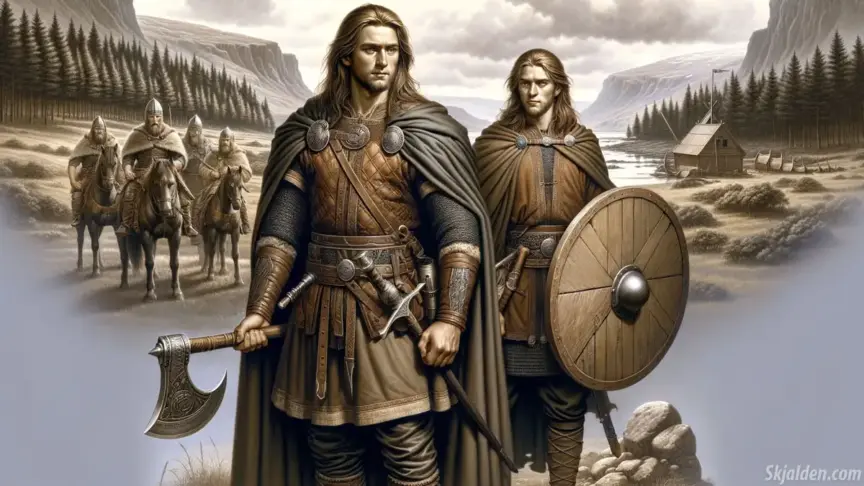
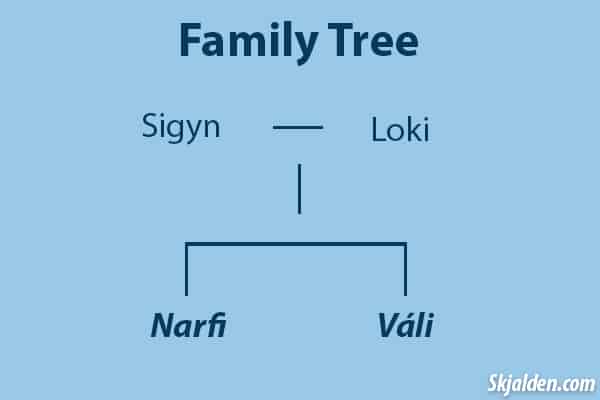
In Norse mythology, Narfi and Váli are two of Loki’s sons. Snorri Sturluson explicitly names Narfi (also called Nari) as Loki’s son with his wife Sigyn; Váli appears later in the same text simply as “Loki’s son,” without his mother named. Both are minor figures — the Eddas don’t credit either with a domain, a skill, or a role of their own among the Aesir. What they’re known for instead is a single, brutal scene: the punishment of their own father.
Narfi or Nari? What the Sources Actually Disagree On
The names aren’t fully settled between sources, and it goes deeper than just spelling. In Snorri Sturluson’s Gylfaginning (chapter 50), the Aesir turn Váli into a wolf, and he kills his brother, Narfi, also called Nari. The prose passage closing the Eddic poem Lokasenna tells it differently: there, Narfi is the one turned into a wolf, and Loki is bound with Nari’s entrails — though this version doesn’t spell out the killing itself the way Snorri’s does.
The two accounts don’t line up cleanly on which brother becomes the wolf and which one dies. This page follows Snorri’s version, since it’s the fuller account and the one most other sources build on, but the disagreement itself is real, not a simplification on this page’s part.
There’s a further wrinkle scholars have raised about Váli specifically: he may not belong in this story at all. A variant manuscript (the Hauksbók) uses the phrase Vála vígbǫnd — “bonds from Váli’s act of slaughter” — in a context that most naturally refers to a completely different figure: Váli, son of Odin, born to avenge Baldur’s death.
The scholar Ursula Dronke has argued Snorri may have misread that phrase and, in effect, invented a second Váli as Loki’s son to make sense of it. If she’s right, “Loki’s son Váli” may be a case of one Norse text quietly misreading another — which would make him even less secure a figure than the naming confusion with Narfi already suggests.
The Binding of Loki
After Loki is caught for his role in Baldur’s death, the Aesir turn Váli into a wolf. In that shape, he attacks and kills his own brother Narfi. The gods then take Narfi’s entrails and use them to tie Loki down over three flat stones — one under his shoulders, one under his waist, one under the backs of his knees.
The bindings then turn to iron. Snorri’s account (Gylfaginning, ch. 50) narrates this as a sequence of events, not a stated plan — it doesn’t say the gods set out to kill Narfi specifically so they could use his entrails, and it doesn’t explain how or why the iron transformation happens either. It simply happens, with no magic named as the cause.
Loki’s binding is often compared with the binding of his son Fenrir — another case of the gods restraining, rather than killing, a figure they expect to break free and fight them at Ragnarök (see John Lindow’s Norse Mythology: A Guide to the Gods, Heroes, Rituals, and Beliefs, 2001).
It’s a pattern with parallels outside Norse myth too — in Greek mythology, Zeus buries the monster Typhon under Mount Etna rather than destroying him, and Typhon’s struggling is said to cause the mountain’s eruptions, much like Loki’s writhing causes earthquakes.
Sigyn’s Vigil: The Serpent, the Bowl, and Earthquakes
The punishment doesn’t end with the binding. The goddess Skaði places a venomous serpent above Loki’s bound body so that its venom drips onto his face. Sigyn stays by her husband’s side, holding a bowl above him to catch the venom before it can reach him.
She can’t stay there forever, though — whenever the bowl fills up, she has to step away to empty it, and in that gap, the venom drips onto Loki’s face. According to Snorri, that’s the exact moment Loki writhes so violently in pain that the earth itself shakes — Gylfaginning‘s own explanation for earthquakes. Loki stays bound like this until Ragnarök, when he finally breaks free to fight against the gods.
Narfi and Váli: Quick Answers
Are Narfi and Váli gods? Not in any active sense — the Eddas don’t give them a domain, a skill, or a role of their own. They appear only in the story of their father’s punishment.
Which brother killed the other, Narfi or Váli? It depends on the source. Snorri’s Gylfaginning says Váli is turned into a wolf and kills Narfi. The prose ending of the Eddic poem Lokasenna has Narfi turned into the wolf instead, and Loki bound with Nari’s entrails — though it doesn’t spell out the killing itself the way Snorri does.
Why did the Aesir turn Váli into a wolf? Snorri presents it as part of Loki’s punishment for his role in Baldur’s death, but doesn’t explain the gods’ reasoning in detail — the text just narrates the wolf-transformation, the killing, and then the entrails-binding as a sequence, not a stated plan.
Is Váli really Loki’s son, or is that a mix-up with Odin’s son Váli? It might be the latter. Scholar Ursula Dronke has argued that a phrase in a variant manuscript — “bonds from Váli’s act of slaughter” — most naturally refers to Váli, son of Odin (Baldur’s avenger), and that Snorri may have misread it into inventing a second, separate Váli as Loki’s son.
What happens to Loki after Narfi’s death? He stays bound with Narfi’s entrails, with a serpent dripping venom onto his face and Sigyn catching what she can, until Ragnarök — when he finally breaks free.
Sources:
Lee M. Hollander (1962) The Poetic Edda. 15th. edition. Texas, USA: University Research Institute of the University of Texas. ISBN 978-0-292-76499-6 — includes Lokasenna, source for the reversed Nari/Narfi naming.
John Lindow (2001) Norse Mythology: A Guide to the Gods, Heroes, Rituals, and Beliefs. Oxford, England: Oxford University Press. ISBN-13 978-0-195-15382-8 — source for the comparative “bound monster” pattern.
Ursula Dronke’s argument on the two Vális is cited here via secondary discussion of her Poetic Edda scholarship, not read directly in her original text — worth a direct check against her own published work before treating it as more than “a real scholarly theory exists.”
Edward Pettit (2023) The Poetic Edda: A Dual-Language Edition. Cambridge, England: Open Book Publishers — a modern open-access scholarly edition and translation of Lokasenna, for readers who want the fuller discussion of this discrepancy.