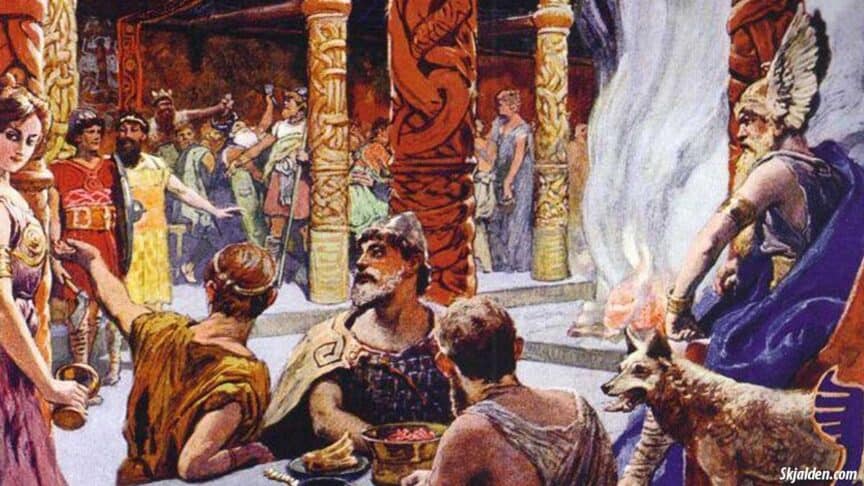
In Norse mythology, Valhalla (Old Norse Valhöll, “hall of the fallen”) is the hall where Odin houses the warriors he judges worthy of dwelling with him. The name comes from two Old Norse words: valr, meaning a body slain on a battlefield, and höll, meaning hall.
The poem Grímnismál says Freya chooses half of the slain each day for her own field, Fólkvangr, and that Odin has the other half in Valhalla. Because Freya does the choosing while Odin simply has the rest, the poem is often read as Freya getting first choice.
Snorri’s retelling in the Prose Edda drops the choosing and only says that she gets half and Odin half. Elsewhere in the same book, he even writes that all who fall in battle are Odin’s adopted sons.
How to Get Into Valhalla?
Snorri’s stated rule is specific: those who die of illness or old age go to Hel. Those who die bravely in battle are carried to Valhalla by Odin’s Valkyries instead.
But that rule doesn’t hold together as cleanly as it sounds. In Snorri’s own telling, Baldur is murdered — he dies neither of illness nor old age, but he still ends up in Hel, not Valhalla. The scholar Hilda Ellis has argued that this kind of gap is a sign the neat Valhalla-or-Hel split is Snorri’s own systemization.
In another chapter, Snorri even gives a different rule: good people go to Gimlé or Vingólf, and the wicked go to Hel and on to Niflhel. He was writing centuries after Viking Age paganism was a living tradition — this wasn’t necessarily a rule Norse pagans themselves ever followed.
Valhalla is consistently associated with Odin, the battle-slain, and the einherjar who will fight beside the gods at Ragnarok. Beyond that core picture, though, the sources leave real gaps — Baldur’s death is one of them.
What Does Valhalla Look Like?
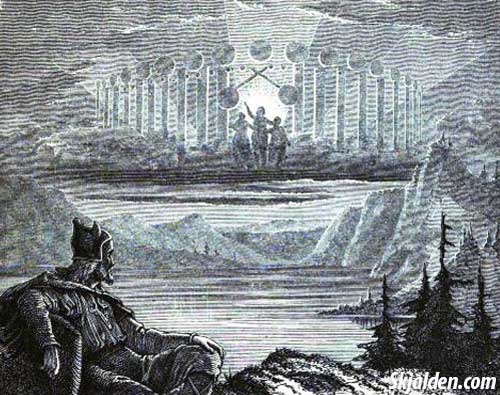
According to the poem Grímnismál, Valhalla’s roof is made of gold-bright shields, held up by spears instead of rafters, with benches made of breastplates. The shield roof is an old image. Snorri quotes a skaldic verse that calls shields “Svafnir’s hall-shingles,” and Svafnir is one of Odin’s names. A wolf hangs over one door, an eagle above it.
The hall has a staggering number of doors, though translations don’t agree on the exact count: some render it as five hundred and forty, others as six hundred and forty.
Old Norse sometimes counted in “long hundreds” of 120 rather than the usual 100. Translators handle that older convention differently, which is likely why the number shifts depending on which edition you’re reading. Either way, the doors are wide enough for eight hundred warriors to walk through side by side.
Six hundred doors
and still forty more,
I believe, are at Valhalla.
Eight hundred Einherjar
will go together out each door
when they go to fight the wolf.
– Grímnismál
What Is Daily Life Like for the Einherjar?
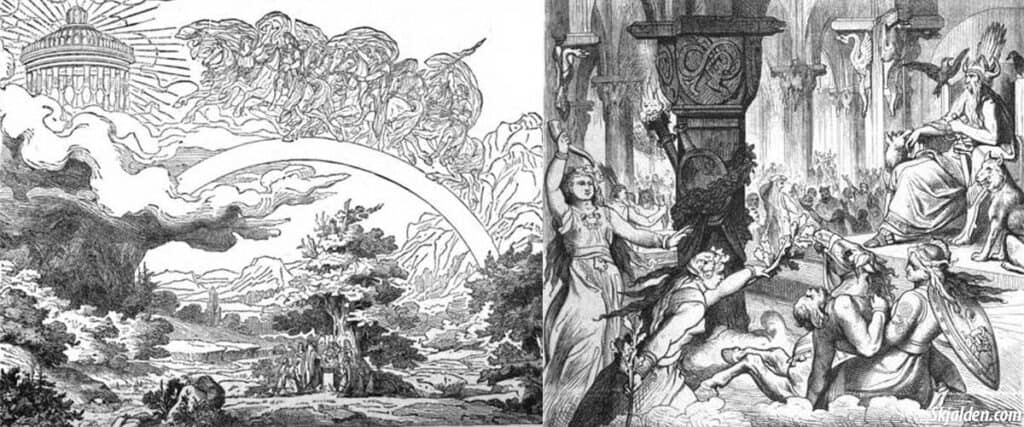
The einherjar — the warriors chosen for Valhalla — fight and are slain each day, in practice for the real battle awaiting them at Ragnarok. Afterward, they ride back from the battlefield and sit down together again, ready to do it all again the next day.
All the Einherjar
in Odin’s home fields
fight among themselves each day.
The slain they select
then ride from the battlefield;
reconciled, they sit again together – Vafþrúðnismál
Each evening they join Odin for a feast. Their meat comes from the boar Sæhrímnir, cooked daily in the pot Eldhrímnir by the cook Andhrímnir — and no matter how much is eaten, the boar is whole again by the next day’s meal. Their mead comes from the goat Heidrun. Odin himself eats nothing, living on wine alone, and feeds his own portion of meat to his two wolves, Geri and Freki.
Andhrímnir has
Sæhrímnir boiled
in Eldhrímnir,
the best of meat.
But few know
on what the Einherjar feed.
– Grímnismál
Could Valhalla Have Had Older Underworld Associations?
Grímnismál, the most detailed source on Valhalla, is clear: it places the hall in Asgard, alongside the other gods’. That part isn’t in dispute.
But some scholars have drawn a comparison to a different story. The medieval Danish historian Saxo Grammaticus tells of the hero Hadding being led underground by a mysterious woman. There, Hadding finds armies of the dead locked in eternal battle — and on the way back, the woman throws a severed rooster’s head over a wall neither of them can cross, where it comes back to life, crowing, on the other side. It’s a real parallel worth knowing about, not a second description of Valhalla itself — nothing ties Hadding’s underground battle-hall directly to Valhalla by name.
There’s also a proposed linguistic connection: Valhöll has been compared to Valhallr, “rock of the fallen,” a name once given to certain hills and rock formations in southern Sweden, an old center of Odin worship. It’s a genuinely interesting theory, not a settled one — the straightforward valr + höll, “hall of the slain,” explanation given at the top of this page remains the one the sources directly support. These parallels may point to older ideas about a warrior afterlife, but they don’t prove Valhalla itself was ever thought to be underground.
Grammar Note: Saying “Til Valhallar”
The correct way to say “to Valhalla” in Old Norse, according to Dr. Jackson Crawford, is til Valhallar, not til Valhöll. That’s because Old Norse nouns change form (decline) depending on their grammatical role, and the preposition til (“to”) requires the genitive case:
Nominative/Accusative: Valhöll
Genitive: Valhallar
Dative: Valhöllu
In Old Norse: Til Valhallar
In Danish: Til Valhal
In Norwegian: Til Valhal
In Swedish: Till Valhall
Valhalla: Quick Answers
What does Valhalla mean in Norse mythology? Valhalla comes from Old Norse Valhöll, “hall of the slain.” Valr means the bodies of those killed in battle, and höll means hall. It is Odin’s hall for the warriors chosen to fight beside the gods at Ragnarok.
What does “Til Valhalla” mean? It means “to Valhalla.” In correct Old Norse it is til Valhallar, because the word til needs the genitive form of the name.
Who gets into Valhalla in Norse mythology? Snorri says warriors who die bravely in battle, while those who die of illness or old age go to Hel instead. But in Snorri’s own story, Baldur is murdered and still ends up in Hel — a real gap scholars like Hilda Ellis point to as a sign this tidy rule was Snorri’s own systemization, not a strict law Norse pagans actually followed.
Where is Valhalla located? Grímnismál clearly places it in Asgard. Some scholars have compared it to a similar underground battle-hall in a different story (Saxo Grammaticus’s tale of Hadding), and to place names in Sweden linked to the dead — interesting parallels, but neither proves Valhalla itself was ever thought to be underground.
What do the einherjar do all day? They fight and are slain each day, then return to feast together, ready to do it again tomorrow — practice for the real battle at Ragnarok. Their food is an endlessly-regenerating boar and mead from the goat Heidrun.
Is Fólkvangr the same place as Valhalla? Possibly — Freya is said to take half the slain to Fólkvangr, but the sources are thin enough that some scholars think Fólkvangr and Valhalla may just be two names or two tellings of the same hall.
Sources:
Jackson Crawford (2019) Video: the word Valhalla
Jackson Crawford (2019) Video: the afterlife
Jackson Crawford (2020) Video: to Valhalla