In Norse mythology, Draupnir is Odin’s magical golden ring. The name Draupnir means “the dripper”, and the ring has earned that name because of a remarkable ability. Every ninth night, eight new rings drip from it, each one of the same weight as Draupnir itself.
Two dwarves made the ring in a bet with Loki, and it was given to Odin. Later it was burned with his son Baldur and sent back from the land of the dead. For a small ring, Draupnir has quite a story to tell.
What Is Draupnir?
The old sources simply call Draupnir a ring. Anthony Faulkes calls it a “gold arm-ring” in his translation of Snorri’s Edda, and John Lindow also calls it Odin’s golden arm ring.
In the Viking Age, weight was what gave a ring its value. The archaeologist Else Roesdahl describes silver rings of a standard weight that came to Scandinavia from the east, from the lands along the river Volga. They were twisted into arm rings and used both as jewellery and as money.
Arm rings could also be cut into pieces to pay for things. In poetry, a generous lord was praised as a giver of rings. Egil’s Saga tells how the English king Athelstan took a gold ring from his own arm and handed it to the poet Egil Skallagrímsson on the point of his sword.
This is why Draupnir was such a special treasure. A ring that makes eight new rings of the same weight every ninth night would make its owner richer and richer. It is a fitting treasure for Odin, the chief of the gods.
How Draupnir Was Made
Draupnir was crafted by the two dwarves Brokkr and Eitri in a bet with the trickster Loki. Snorri Sturluson tells the story in Skáldskaparmál, and it all starts with a prank.
Loki’s Bet
Loki had cut off the hair of Sif, the wife of Thor. Thor was furious and would have broken every bone in Loki’s body. To save himself, Loki promised to get Sif new hair made of real gold.
Loki went to the dwarves known as the Sons of Ivaldi. They made Sif’s new golden hair, and they also made Freyr‘s ship Skíðblaðnir and Odin’s spear Gungnir.
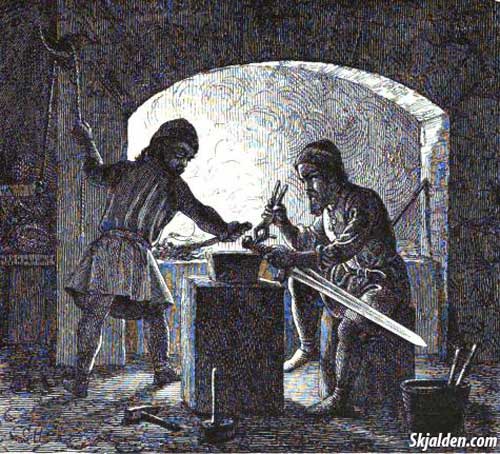
Then Loki made a bet with a dwarf named Brokkr. He bet his own head that Brokkr’s brother, Eitri, could not make three treasures as good as these. Eitri would do the forging, while Brokkr worked the bellows to blow air into the fire.
The Fly in the Forge
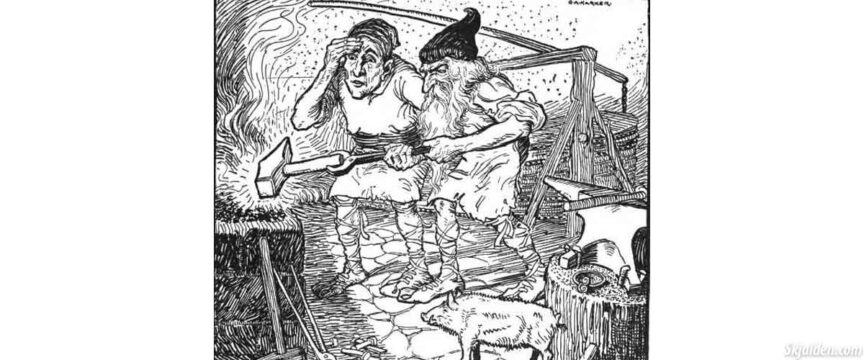
Eitri placed a pigskin in the forge and told his brother not to stop working the bellows until he took it out again. Because Loki did not want to lose the bet, he shapeshifted into a fly, flew into the workshop, and bit Brokkr on the hand. Brokkr was not bothered in the slightest and kept working. When Eitri pulled the treasure out of the forge, it was a boar with bristles made of gold, Gullinbursti.
Next, Eitri poured gold into the forge, and again he asked Brokkr to keep the fire going with the bellows. As soon as Eitri had turned his back, the fly came back and bit Brokkr on the neck, this time twice as hard. It still did not stop him. When Eitri came back and pulled the next treasure out of the forge, it was the golden ring Draupnir.
For the last treasure, Eitri placed iron in the forge. This time Loki knew he had to stop Brokkr, or he would lose the bet. The fly settled between Brokkr’s eyes and bit his eyelids so hard that they bled. The blood ran into his eyes, and he could no longer see what he was doing. For a brief moment Brokkr let go of the bellows to swat the fly away.
When Eitri came back, he said that everything in the forge had almost been ruined. He pulled out the last treasure, a hammer, which would become Thor’s hammer Mjölnir. Because of the short break at the bellows, the handle of Mjölnir came out a little too short.
Loki Loses His Head, Almost
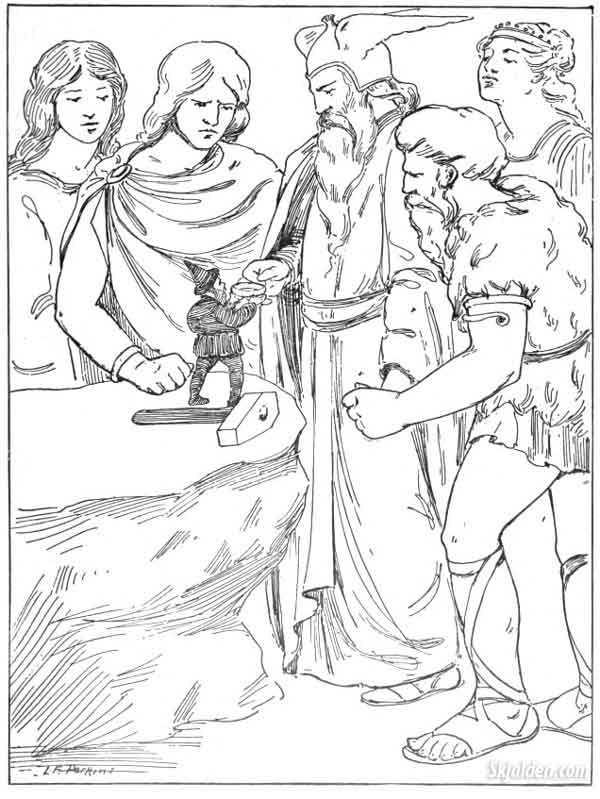
Brokkr, Loki and the treasures travelled to Asgard, where Odin, Thor and Freyr would judge the bet. Odin received Draupnir, Freyr received the boar, and Thor received the hammer. The gods agreed that Mjölnir was the best of all the treasures, because it would protect them against the frost giants. Loki had lost the bet.
Loki did not want to lose his head, so he offered the dwarf gold instead. Brokkr would not hear of it. Loki, who is always quick to save his own skin, ran away. He yelled back that if Brokkr wanted his head, he would have to catch him first. Loki had shoes that could carry him over sky and sea. Brokkr asked Thor to catch Loki, and Thor brought him back.
At this moment Loki came up with another trick. He said that Brokkr had only won his head, not his neck, so Brokkr had no right to touch the neck. The head could not be taken without cutting the neck, so Brokkr had to give up. Instead, he decided to sew Loki’s mouth shut. But his knife would not cut through Loki’s lips.
Brokkr wished that his brother Awl was there, and as soon as he said the name, the awl appeared and pierced the lips. Brokkr stitched them together with a thong called Vartari. He did not get the head, but at least he did not have to hear Loki speak anymore.
Brokkr and Eitri, or Brokkr and Sindri?
Many retellings, and the video game God of War, call the two brothers Brokkr and Sindri. Snorri himself names them Brokkr and Eitri, and John Lindow notes that Brokkr is known from no other source. The name Sindri comes from somewhere else.
In Völuspá, stanza 37, Sindri’s family owns a hall of gold in the north, on the fields called Niðavellir. Snorri reads it differently. In Gylfaginning, Sindri is the name of the hall itself. It is a hall of red gold where good and righteous people will live after Ragnarök.
Lindow adds that sometime after the Middle Ages, an owner of the main manuscript of Snorri’s Edda wrote “Brokk and Sindri” in the margin next to the story. That small note in the margin is most likely why so many people know the smith as Sindri today.
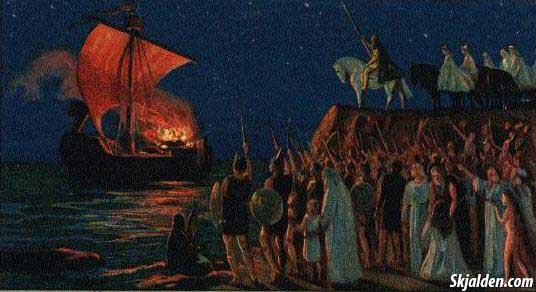
Draupnir’s most famous moment comes at the death of Baldur, Odin’s son. In Gylfaginning, Snorri tells that Odin laid the ring on Baldur’s funeral pyre, together with Baldur’s horse and all its gear. So Baldur had the ring with him when he came to Hel.
When Hermod the brave rode to Hel to ask for Baldur’s release, Baldur sent Draupnir back with him as a keepsake for Odin. Baldur’s wife Nanna sent gifts too, a linen robe for Frigg and a finger ring for Frigg’s servant Fulla.
So Draupnir had been to Hel and back, even though Baldur himself could not return. John Lindow suggests that the ring’s journey through the funeral fire and the world of the dead must have made it even more valuable.
Draupnir and Gerd: The Ring That Could Not Buy Love
The ring appears once more in the poem Skírnismál. The god Freyr has fallen in love with the giantess Gerd, and he sends his servant Skírnir to win her for him. Skírnir first offers her golden apples. When she refuses, he offers her a ring that was burned with Odin’s young son. Every ninth night, eight rings of the same weight drip from it.
In the Old Norse poem, the ring is not named, but as John Lindow points out, it can only be Draupnir. Some translations, such as Lee M. Hollander’s, simply write the name into the stanza. This also tells us something about the order of the myths. As Lindow points out, the ring had already been burned with Baldur, so Baldur must already be dead when Freyr tries to win Gerd.
Gerd is not impressed. She tells Skírnir that there is no lack of gold in the home of her father, Gymir. The ring that had been to Hel and back, the most famous ring of the gods, could not buy her love.
Draupnir in the Poems of the Skalds
Draupnir must have been well known in the Viking world. Lindow points out that many skalds, the Norse court poets, used the name in kennings for gold. A kenning is a poetic way of naming something without saying it directly. In Skáldskaparmál, Snorri lists ways of saying gold such as “drops of Draupnir” and “rain from Draupnir”. The ring had become part of the poets’ language.
The skalds could also call Baldur “the owner of Draupnir”, so the ring stayed tied to him even after it went back to Odin. Oddly, the only Draupnir named in the Old Norse Eddic poems is not the ring at all. It is a dwarf in the long list of dwarves in Völuspá.
Draupnir is not the only ring in the old stories that makes wealth. The translator Jesse Byock compares it to Andvaranaut, the ring Loki takes from the dwarf Andvari. He also notes that the Danish writer Saxo Grammaticus tells of a gold ring that made its owner rich, in his own version of the story of Baldur.
Draupnir in Popular Culture
In the video game God of War Ragnarök (2022), Draupnir was made for Odin by the dwarf brothers Brok and Sindri. In the myth, the smith is Eitri, but the game uses the name Sindri instead. The ring has been copying itself ever since, and the brothers have so many copies that they use them as scrap metal in their forge. The original ring is turned into a new weapon for Kratos, the Draupnir Spear. If you like games inspired by the Viking world, take a look at my list of Viking video games.
Eitri, the dwarf who forged Draupnir, has also found fame on the big screen. In the Marvel film Avengers: Infinity War (2018), a giant version of Eitri forges Thor’s new weapon, Stormbreaker, on a world called Nidavellir. The name comes from the same stanza of Völuspá that places the golden hall of Sindri’s family on Niðavellir.
Frequently Asked Questions About Draupnir
What is Draupnir in Norse mythology?
Draupnir is Odin’s magical gold ring, most likely an arm ring. Every ninth night, eight new rings of the same weight drip from it.
What does the name Draupnir mean?
Draupnir means “the dripper”, because new rings drip from it every ninth night.
Who made Draupnir?
The dwarf Eitri forged Draupnir while his brother Brokkr worked the bellows, as part of a bet with Loki. Many modern retellings call the brothers Brokkr and Sindri, but Snorri names them Brokkr and Eitri.
What happened to Draupnir?
Odin laid Draupnir on Baldur’s funeral pyre. Baldur later sent it back from Hel with Hermod as a keepsake for Odin.
Is Draupnir the ring Skírnir offers Gerd?
Yes. In Skírnismál, Skírnir offers Gerd a ring that was burned with Odin’s son and drips eight rings every ninth night. The poem does not name it, but John Lindow points out that it can only be Draupnir. Gerd refuses it, because her father has plenty of gold.
Is Draupnir in God of War?
Yes. In God of War Ragnarök, the dwarves Brok and Sindri made Draupnir for Odin, and the original ring is turned into the Draupnir Spear for Kratos. In the myths, the smiths are Brokkr and Eitri, and the ring stays with Odin.
Sources:
Jesse Byock (2005) Snorri Sturluson, The Prose Edda. 1st edition. London, England: Penguin Books Ltd. ISBN-13 978-0-140-44755-2 — source for the making of Draupnir, Baldur’s funeral, and the comparison with Andvaranaut and Saxo.
Anthony Faulkes (1995) Snorri Sturluson, Edda. 3rd edition. London, England: Everyman J. M. Dent. ISBN-13 978-0-4608-7616-2 — source for Draupnir as a “gold arm-ring”, the gold kennings, and Loki’s stitched lips.
Lee M. Hollander (1962) The Poetic Edda. 15th edition. Texas, USA: University Research Institute of the University of Texas. ISBN 978-0-292-76499-6 — includes Skírnismál and Völuspá.
John Lindow (2002) Norse Mythology: A Guide to the Gods, Heroes, Rituals, and Beliefs. Oxford, England: Oxford University Press. ISBN-13 978-0-195-15382-8 — entries on Draupnir, Brokk and Sindri.
Else Roesdahl (1998) The Vikings. Revised edition. London, England: Penguin Books. ISBN-13 978-0-140-25282-8 — source for Viking-Age arm rings as jewellery and money, and Egil’s ring from King Athelstan.