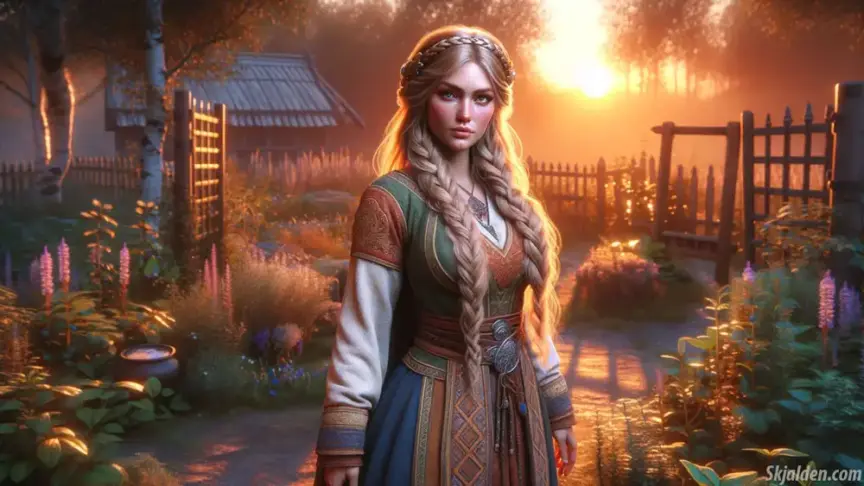
Sif is a goddess in Norse mythology best known for two things: her golden hair, and being married to Thor. She has a son, Ullr, whose father is never named in any surviving source — making Ullr Thor’s stepson rather than his son. In his list of poetic names, Snorri also calls her the mother of Thrúd, a daughter of Thor. Beyond that, Sif is genuinely obscure.
The Eddas define her almost entirely through her relationship to Thor and through one story about her hair, rather than giving her a role or domain of her own. In the Prologue to his Edda, Snorri even writes that no one is able to tell Sif’s ancestry. There he turns her into Sibyl, a prophetess with hair like gold.
How Sif Lost Her Golden Hair
In Skáldskaparmál, part of Snorri Sturluson’s Prose Edda, Loki sneaks in while Sif is asleep and cuts off all of her hair as a prank. When Thor finds out, he threatens Loki, who scrambles to fix what he’s done. Loki goes to a group of dwarves known as the Sons of Ivaldi. He has them forge Sif new hair out of real gold, fine enough to grow onto her head like natural hair once it is set in place.
The same visit produces two other famous treasures: Odin’s spear Gungnir and Freyr’s folding ship Skíðblaðnir. Loki does not stop there, either. He goes on to bet his own head with the dwarf Brokkr that Brokkr’s brother cannot forge anything better. That wager ends up producing Mjölnir itself. That fuller story, including how Loki tries to cheat his way out of the bet, is told on the Treasures of the Gods page — this page focuses on Sif’s own part in it.
Sif in the Eddic Poems
Sif appears in only two Eddic poems, and both times the subject is her faithfulness to Thor. In Hárbarðsljóð, Odin, disguised as a ferryman, teases Thor that Sif has a lover at home.
In Lokasenna, Sif offers Loki a drink and asks him to leave her alone, since she is blameless. Loki answers that he once slept with her himself. John Lindow points out that Loki makes the same kind of accusation against almost every goddess in the poem, so it proves very little.
Is Sif a Fertility Goddess? What Scholars Actually Disagree On
Sif is commonly described as a goddess of grain or fertility, but this isn’t something the Eddas state directly. The theory rests on two things: the symbolism of her golden hair, and a comparative-mythology parallel to sky-god/earth-goddess pairings found across other cultures.
Her actual name does not support it. Scholars including John Lindow and Rudolf Simek agree that “Sif” comes from an Old Norse word meaning “relation by marriage.” That meaning has no connection to fertility or earth at all.
The scholar Hilda Ellis Davidson argued anyway that Sif’s hair represents a field of ripe, golden grain. She also argued that Sif’s marriage to Thor echoes a much older Indo-European idea. In that idea, a sky god who brings rain and thunder is paired with an earth goddess, the fertile soil the rain falls on. The same pattern is found in Greek, Roman, Celtic, and Indian mythology.
Not every scholar agrees. Rudolf Simek rejects the idea of a “vegetation cult” around Sif entirely, calling the golden-hair-as-grain theory an “over-zealous interpretation” of Snorri’s writing. He goes further still. He suggests that Snorri may have invented the hair-cutting story itself, as a colorful way to explain how the gods ended up with Gungnir, Skíðblaðnir and their other treasures.
In that case, it would not be a genuine older myth about Sif. In his view, Sif doesn’t appear to have had any real function in Norse religion beyond being Thor’s wife. Both scholars are working from the same thin evidence — the real answer is that nobody knows for certain.
Sif: Quick Answers
Is Sif a fertility goddess in Norse mythology? It’s disputed. Hilda Ellis Davidson argued her golden hair symbolizes grain and connects her to an old sky-god/earth-goddess pairing with Thor. Rudolf Simek rejected that reading entirely, calling it an “over-zealous interpretation” and suggesting Snorri may have invented the hair-cutting story itself rather than inherited it.
How did Sif lose her hair in Norse mythology? Loki cut it off while she slept, as a prank, in the story told in Skáldskaparmál.
Did Loki make Sif’s new hair himself? No. Loki had a group of dwarves, the Sons of Ivaldi, forge it out of real gold, fine enough to grow onto her head like natural hair.
Who is Ullr, Sif’s son? Ullr is Sif’s son from an unnamed father, making him Thor’s stepson. He’s known as a skilled archer and skier.
Sources:
John Lindow (2001) Norse Mythology: A Guide to the Gods, Heroes, Rituals, and Beliefs. Oxford, England: Oxford University Press. ISBN-13 978-0-195-15382-8 — source for the etymology of Sif’s name.