In Norse mythology, the Valkyries (Old Norse: valkyrja, plural valkyrjur) are female beings who serve Odin. Their role is to decide which of the warriors who fall in battle will go to the afterlife in Valhalla. Valkyrja is two words put together: valr, “the slain on a battlefield”, and kjósa, “to choose”. In plain English, they are often just called the choosers of the slain.
Not all valkyries are the same kind of being. In the heroic poems, several of them are the daughters of kings, like Brynhild and Sigrún. In the poem Grottasöngr, two giantesses even say that they once fought in battle like valkyries.
The Role of the Valkyries
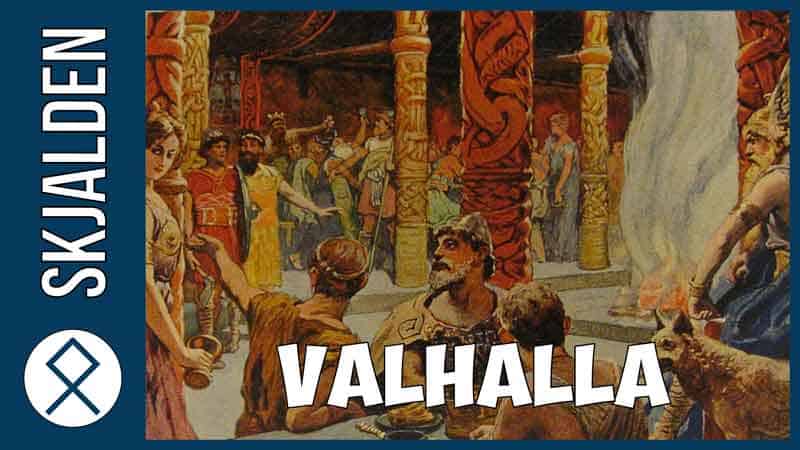
The Valkyries are the servants of Odin in his great hall, Valhalla. One of their duties is to serve the warriors in their afterlife with drink. They fill the horns with mead from the enormous vat in Valhalla, which is constantly being filled by the she-goat Heidrun.
I wish that Hrist and Mist
would bring me my horn!
Skeggjöld and Skogul,
Hildr and Thrud,
Hlokk and Herfjötur,
Göll and Geirölul
Randgrid and Radgrid,
and Reginleif
they bring mead to the Einherjar.
– Grímnismál 40-41.

Their other duty is on the battlefield. Snorri Sturluson writes that Odin sends them to every battle, where they choose which men are to die and decide who wins. He adds that Gunn, Róta and Skuld, the youngest of the Norns, always ride out to choose the slain.
In the poems, the Valkyries often ride in groups of three or nine. They come over the battlefield mounted on their horses, in helmets and mail, with spears in their hands. They judge among the fallen and choose the bravest of the warriors to join Odin in the afterlife.
There are no records of male Valkyries; all of the Valkyries are female. They are not objects of beauty just to be admired, and their role in the hall is just one of their responsibilities. Several of them also fall in love with human heroes. In the Helgi poems, the valkyrie Sigrún protects the hero Helgi in battle and becomes his wife.
Valkyries, Freya and Fólkvangr
The chosen are brought to Asgard, where the goddess Freya has the right to choose half for her field called Fólkvangr. When she has picked her half, the rest go to Valhalla.

Dr. Jackson Crawford, who is an expert in Norse mythology, has speculated that Fólkvangr may in fact just be another name for Valhalla. Highlighting Freya by mentioning that she gets to choose half could have been a sign of her importance. It is possible that Freya is the one in charge of the Valkyries, but no Old Norse source says so directly.
Valkyries and Swan Maidens
The Valkyries can also appear as swan maidens. In the poem Völundarkviða, three valkyries lay their swan coats aside by a lake, and the smith Völund and his two brothers take them as wives. After seven winters, the valkyries fly away to war again.
The same idea appears in the poem Helreið Brynhildar. There a king takes the feather coats of Brynhild and her sisters, and Brynhild ends up bound by oaths to him.
Brynhild: The Valkyrie Who Defied Odin
The most famous valkyrie is Brynhild. In the poem Sigrdrífumál, a valkyrie gives victory to the wrong king in a battle where Odin had promised the other side the win. As punishment, Odin pricks her with a sleep-thorn and leaves her asleep on a mountain, until the hero Sigurd rides through the fire and wakes her.
In that poem she is called Sigrdrífa. Lee M. Hollander, who translated the Poetic Edda, thought this was not a second valkyrie at all. He read Sigrdrífa as a title meaning “giver of victory”, used for Brynhild herself. Snorri also calls Brynhild a valkyrie, and her love for Sigurd ends in one of the great tragedies of Norse legend.
Valkyries in Viking Age Poetry
The Valkyries appear in poetry long before Snorri wrote about them. Around the year 961, the poet Eyvind skáldaspillir composed Hákonarmál in memory of the Norwegian king Hákon the Good. In the poem, the valkyries Göndul and Skögul watch the king’s last battle. Skögul then tells Hákon that the valkyries gave him the victory and will now take him to the gods. The scholar John Lindow points out that in this poem, it is the valkyries who seem to make the choice, not Odin.
The most chilling valkyrie poem is Darraðarljóð, preserved in Njal’s Saga. The saga says that on the morning of the Battle of Clontarf in Ireland, in 1014, a man named Dörruð saw something strange. In a hut in Caithness, in the north of Scotland, women were weaving at a loom. Their loom was made of human heads and entrails, and they sang that valkyries decide who lives and who dies in the battle.
List of Valkyries Names in Norse Mythology
The total number of Valkyries is uncertain, but we do have a list of 23 Valkyrie names and the meaning of the names. These names are mentioned in the old Icelandic sources Grímnismál, Völuspá, the Helgi poems, Völsunga saga and Sigrdrífumál.
| Name | Meaning | Source |
|---|---|---|
| Hrist | Shake | Grímnismál |
| Mist | Mist | Grímnismál |
| Skeggjǫld, or Skeggjöld | Axe age | Grímnismál |
| Skǫgul, or Skögul | Projector | Grímnismál |
| Hildr | Battle | Grímnismál |
| Þrúðr, or Thrúd | Strength (with a of supernatural strength) | Grímnismál |
| Hlǫkk, or Hlökk | Cry of an eagle | Grímnismál |
| Herfjǫtur, or Herfjötur | War fetter, or war chain, or war wife | Grímnismál |
| Gǫll, or Göll | Noise | Grímnismál |
| Geirǫlul, or Geirölul | Uncertain (geir means spear) | Grímnismál |
| Randgríðr, or Randgrid | Shield eager | Grímnismál |
| Ráðgríðr, or Rádgrídr | Advice eager | Grímnismál |
| Reginleif | Divine survivor, or remnant | Grímnismál |
| Skuld | Should | Völuspá |
| Skǫgul, or Skögul | Projector | Völuspá |
| Gunnr | Battle | Völuspá |
| Hildr | Battle | Völuspá |
| Gǫndul, Göndul | The magical one, or the monstrous one | Völuspá |
| Geirskǫgul, or Geirskögul | Spear projector | Völuspá |
| Sváva | Put to sleep | Helgakviða |
| Sigrún | Victory rune, or victory mystery | Hundingsbana I, Hundingsbana II |
| Brynhildr | Armor warrior | Völsunga |
| Sigrdrífa | Victory driver (the one who makes victory happen) | Sigrdrífumál |
The Valkyrie Statue in Copenhagen
The Valkyries have inspired artists for centuries. In Copenhagen, a bronze Valkyrie on horseback by the sculptor Stephan Sinding stands in Churchillparken. It was cast in 1908, and you can read more about it in my guide to the Valkyrie statue in Copenhagen.
Valkyries: Quick Answers
What is a valkyrie in Norse mythology? A valkyrie is a female being who serves Odin. She chooses which warriors die in battle, brings the chosen to Valhalla and serves them mead there.
What does valkyrie mean? Valkyrie comes from Old Norse valkyrja, “chooser of the slain”. It is made of valr, the slain on a battlefield, and kjósa, to choose.
How many valkyries are there? No source gives a total. Grímnismál names thirteen, Völuspá names six, and Snorri and the heroic poems add more. Together the lists hold more than twenty names.
Are there male valkyries? No. Every valkyrie named in the sources is female.
Is Freya the leader of the valkyries? No source says so directly. Freya chooses half of the slain for her field Fólkvangr, which is why some people see her as their leader.
Did valkyries have wings? No. In the sources they ride horses, and in the poems they wear helmets and mail. The winged helmets come from 19th-century art and opera, not from the Old Norse texts.
Who is the most famous valkyrie? Brynhild. Odin punishes her with a sleep-thorn for giving victory to the wrong king, and she is woken by the hero Sigurd.
Sources:
Lee M. Hollander (1962) The Poetic Edda. 15th edition. Texas, USA: University Research Institute of the University of Texas. ISBN 978-0-292-76499-6 — includes Grímnismál, Völuspá, the Helgi poems, Völundarkviða, Helreið Brynhildar, Sigrdrífumál and Grottasöngr.
John Lindow (2002) Norse Mythology: A Guide to the Gods, Heroes, Rituals, and Beliefs. Oxford, England: Oxford University Press. ISBN-13 978-0-195-15382-8 — source for Hákonarmál.
Robert Cook (2001) Njal’s Saga. London, England: Penguin Classics. ISBN-13 978-0-140-44769-9 — source for Darraðarljóð.