In Norse mythology, there are quite a few different animals that live among the branches of the great world tree Yggdrasil. Two of these animals live at the top of the tree, on top of the great hall called Valhalla (Old Norse: Valhöll).
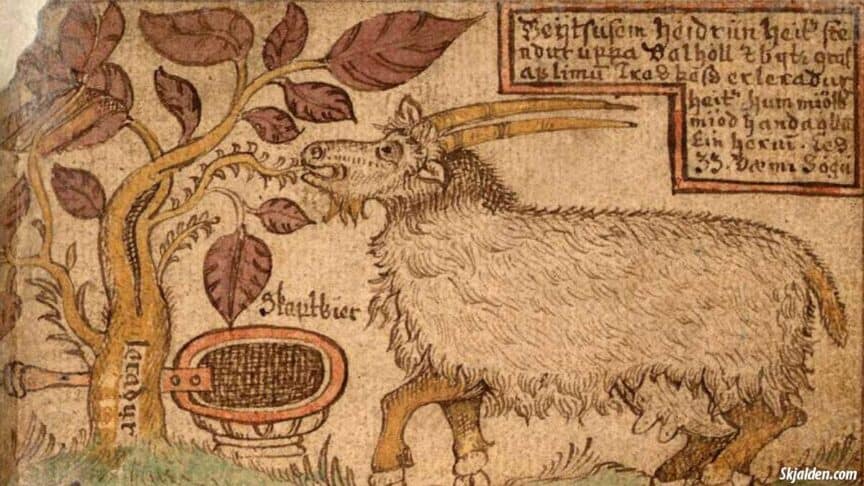
One of them is a she-goat called Heidrun (Old Norse: Heiðrún) and the other is a stag called Eikthyrnir (Old Norse: Eikþyrnir). Both of them eat the leaves from the branches of the tree.
They may look like ordinary animals, but both have an important job. The goat gives Odin’s warriors their mead, and the stag gives the world its rivers.
Heidrun: The Goat Whose Mead Never Runs Out
In Snorri Sturluson’s Prose Edda, a man called Gangleri asked if the warriors in Valhalla drank water. He was told that it would be strange if Odin invited kings and earls to his hall and only gave them water to drink. Instead, he was told about the goat Heidrun, who stands on top of Valhalla.
From the udders of the she-goat flows an endless stream of the clearest mead, and every day it fills a big vat. There is enough for all the fallen warriors, the einherjar, to get fully drunk. They drink this mead while eating the tasty pork from the great pig Sæhrímnir, which is cooked every day and is whole again by evening.
The scholar John Lindow points out that this makes Heidrun a match for Sæhrímnir. The pig gives food that never runs out, and the goat gives drink that never runs out.
Heidrun is named in one more poem, Hyndluljóð. At the end of the poem, Hyndla, who seems to be a giantess, insulted Freya. She said that Freya ran around at night like Heidrun running with the billy goats. Lindow thinks this links Heidrun to the drinking in Valhalla rather than to fertility, as some older scholars believed.
The meaning of the name Heidrun is unknown. According to Lindow, people in the Viking Age would probably have heard the first part of the name as “bright”. Heidrun gives Odin’s warriors their drink, and the stag next to her gives water to the whole world.
Eikthyrnir: The Stag Whose Horns Feed the Rivers
The stag Eikthyrnir stands on top of Odin’s hall (most likely Valhalla) and eats from the same tree as Heidrun. From its horns drip drops of some kind of liquid (maybe water) into the well Hvergelmir. Snorri places this well in Niflheim, under one of the roots of Yggdrasil.
From Hvergelmir, the water runs out into the rivers called Síd, Víd, Søkin, Eikin, Svöl, Gunnthrá, Fjörm, Fimbulthul, Gípul, Göpul, Gömul, Geirvimul, Thyn, Vín, Thöll, Höll, Grád, Gunnthráin, Nyt, Nöt, Nönn, Hrönn, Vína, Vegsvinn and Thjodnuma. The poem Grímnismál puts it more simply: from Hvergelmir, “all waters have their ways”.
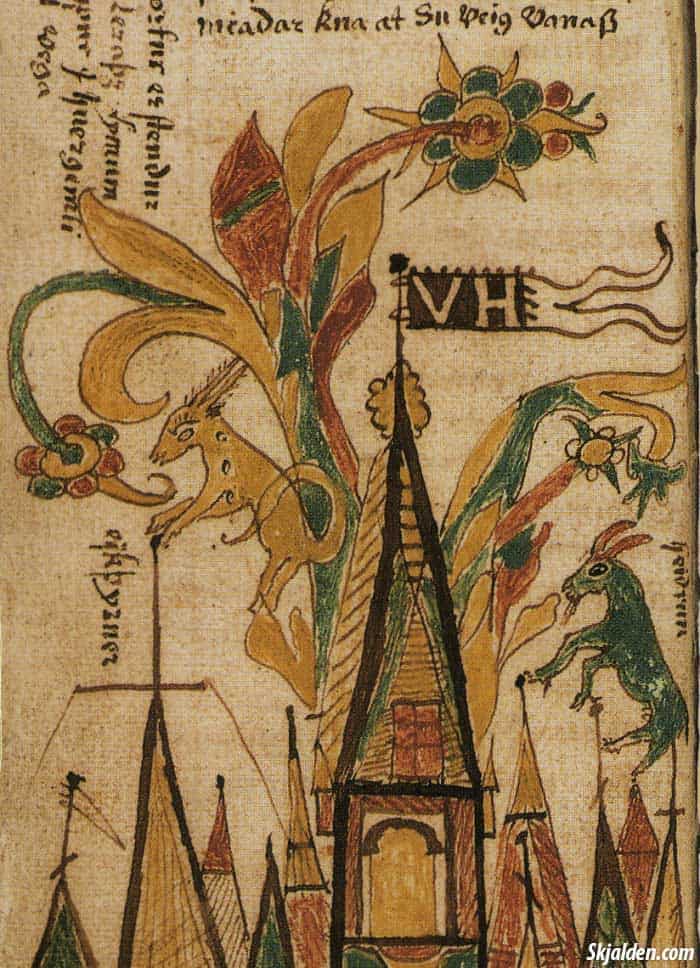
Jesse Byock translates the name Eikthyrnir as “Oak Antlers”, while John Lindow translates it as “Oak-encircler”. In 1917, the Danish scholar Axel Olrik pointed to the oak tree and the large stag.
He used them to argue that the idea of Yggdrasil came from Denmark or western Norway.
Is Læraðr the Same Tree as Yggdrasil?
In the Poetic Edda, and in Snorri’s Prose Edda too, Heidrun and Eikthyrnir eat from a tree called Læraðr. Most scholars think that Læraðr is another name for the great world tree Yggdrasil.
John Lindow calls it “almost certainly the world tree”. Læraðr stands at Odin’s hall in the middle of the world, and the well Hvergelmir is linked to both trees.
Heidrun and Eikthyrnir: Quick Answers
What is Heidrun in Norse mythology? Heidrun is a goat that stands on top of Valhalla, Odin’s hall, and eats from the tree Læraðr. Mead flows from her udders, and there is always enough for all the warriors in Valhalla.
What is Eikthyrnir in Norse mythology? Eikthyrnir is a stag that stands on Odin’s hall and eats from the same tree as Heidrun. Water drips from its horns into the well Hvergelmir, and from there all the rivers flow.
What comes from Heidrun’s udders? Mead. Snorri says that she fills a vat every day, and the poem Grímnismál says that the drink can never run out.
What does the name Eikthyrnir mean? Jesse Byock translates it as “Oak Antlers”. John Lindow translates it as “Oak-encircler”.
Is Læraðr the same as Yggdrasil? Most likely. The sources never say so directly, but most scholars, including John Lindow, think that Læraðr is another name for the world tree.
Sources:
Lee M. Hollander (1962) The Poetic Edda. 15th. edition. Texas, USA: University Research Institute of the University of Texas. ISBN 978-0-292-76499-6 — includes Grímnismál and Hyndluljóð.