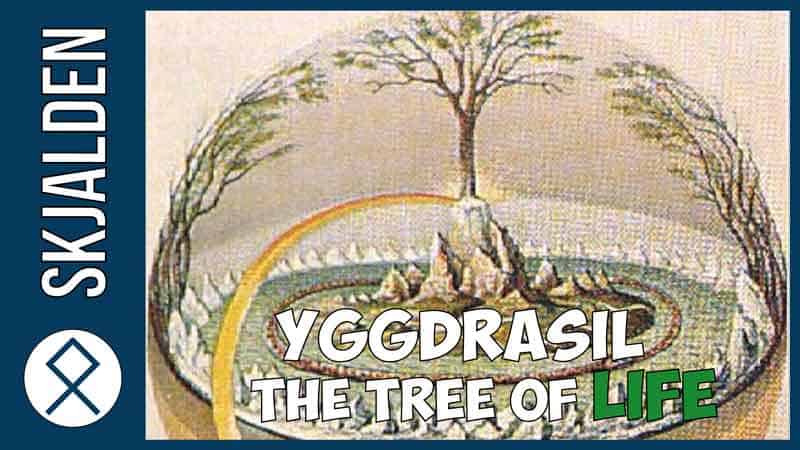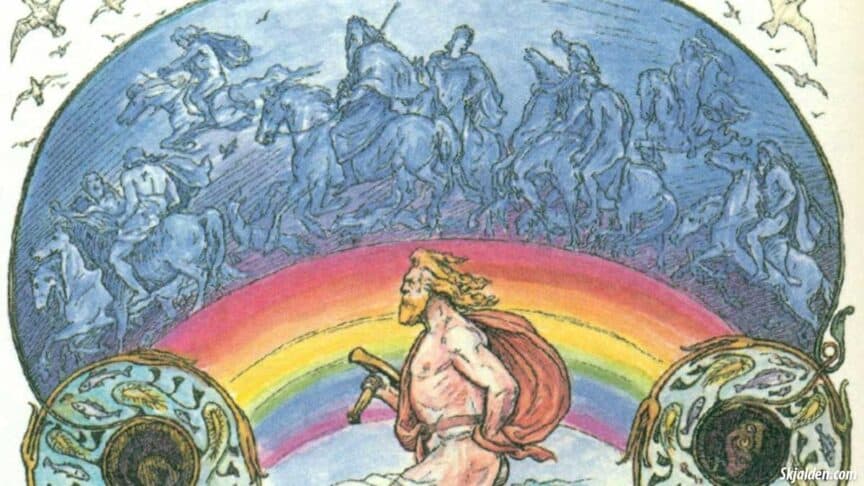
In Norse mythology, Bifrost (Old Norse: Bifröst) is the rainbow bridge that connects Asgard (home of the gods) with Midgard (home of mankind). The gods made the bridge themselves, and like a rainbow, it has three colors. One of those colors is a burning fire, which keeps the giants from walking up into Asgard. The god Heimdall guards the bridge day and night, but no matter how well it is guarded, Bifrost will not survive Ragnarok.
Why Is the Rainbow Bridge on Fire?
Only one of the three colors is named in the sources, and that is red (Old Norse: rauðr). The red color is burning fire, and it is there to keep the frost giants and the mountain giants out. Without it, they could walk straight up into Asgard.
The fire does more than keep the giants away. It also makes life harder for one of the gods.
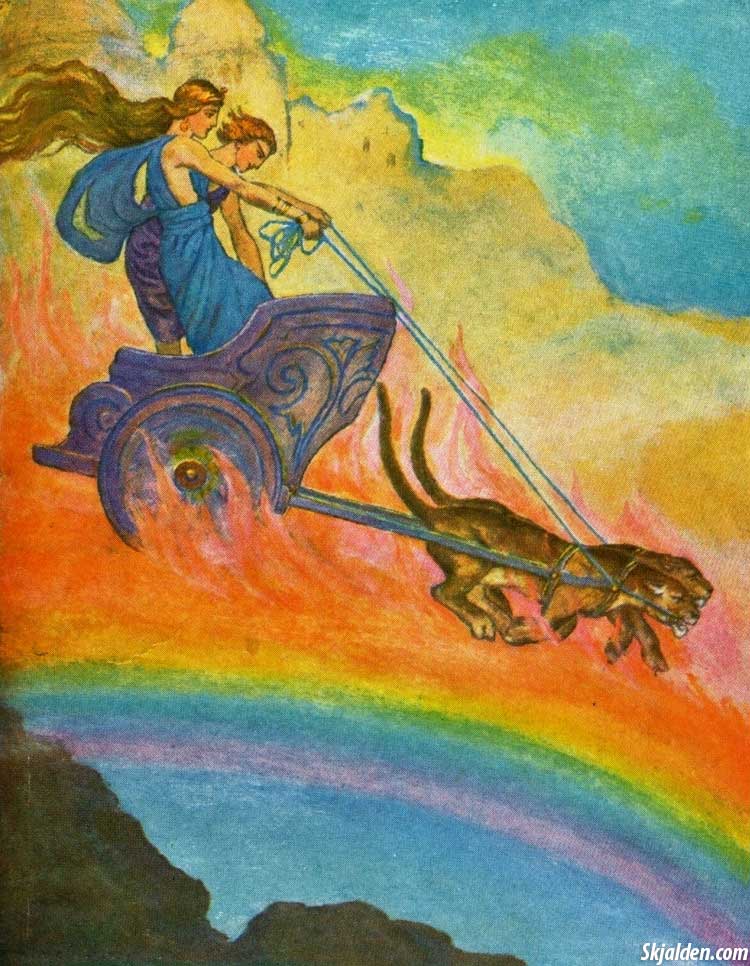
In Snorri’s account, the gods ride over Bifrost every day to their court at the Well of Urd, under the world tree Yggdrasil. Thor, however, walks. The poem Grímnismál says that he wades through four rivers to get there, because the bridge is “ablaze with flames”.
If you think that sounds a bit strange, you are not the only one. The Well of Urd lies under Yggdrasil in Asgard, so why would the gods need a bridge to get there? The poem only says that “the bridge of the gods” burns. The scholar John Lindow points out that this may not mean Bifrost at all. It may be Snorri who joined the two stories together.
In Old Norse, bifask means to “tremble”, and röst means “mile”. Which would mean that if it were spelled Bifröst the name of the rainbow bridge could be translated into “the trembling mile”. However, if it is spelled “Bilröst” as it is in the Poetic Edda, it could be translated into “the blinking mile” or “the winking mile”.
According to Dr. Jackson Crawford, “bil” In Old Norse means “moment or failure”, this is based on one of Odin’s names “Bileygr”, which means either wavering or winking-eyed.
Besides the two names Bifröst and Bilröst, the bridge has also been called Ásbrú (Aesir bridge) in the Prose Edda by Snorri Sturluson.
The guardian of Bifrost
It is the god Heimdall that is the guardian of the rainbow bridge, and therefore, he is a symbol of the preservation of the cosmos. He is the communication link between the gods and goddesses and mankind.
Heimdall was probably chosen to fulfill this important task based on his incredible ability to see hundreds of kilometers. And should the weather be cloudy, it won’t matter to Heimdall, because he also has an incredible hearing, in fact, he can even hear the wool grow on the back of a sheep.
Heimdall is equipped with a horn named Gjallarhorn, which means “the yelling horn” or “the loud sounding horn”. This horn can make a sound that is so loud that it can be heard in all the realms. At Ragnarök, it is this horn that will warn all of the Aesir that the war is about to begin. This will also be the day that Bifrost will be destroyed.
If a jötunn should be stupid enough to try and attack or sneak into Asgard, then Heimdall has his trustworthy sword named Hofund at his side. But it is very unlikely that a jötunn will make it up the rainbow bridge. Because the bridge is always on fire, and it is so hot that it always has a red glow.
Sources:
Jackson Crawford (2018) https://www.youtube.com/watch?v=ILAERgb3V0o&ab_channel=JacksonCrawford