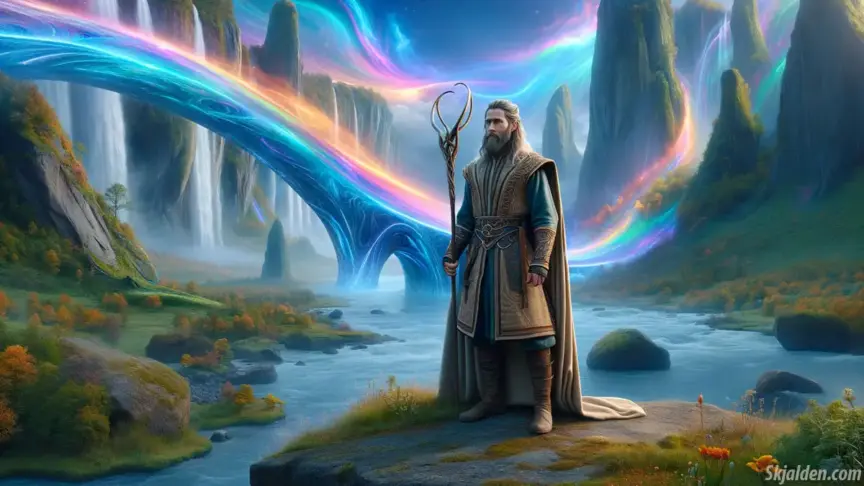
In Norse mythology, Heimdall (Old Norse: Heimdallr) is the guardian of the gods. His job is to watch over the rainbow bridge Bifrost, which connects Asgard, the realm of the gods, with Midgard, the realm of humans.
Day and night, Heimdall sits at the end of the bridge and keeps an eye out for giants. It is a fitting job for a god who always seems to stand at the edge of things. He was born at the edge of the earth and lives at the edge of Asgard. And when the world comes to an end, he is the one who blows the horn.
What Is Heimdall the God Of?
Many gods in Norse mythology are linked to one thing, like Thor to thunder. Heimdall is different. Snorri Sturluson simply calls him the guardian of the gods, and that is what he is best known for.
Snorri also calls him the white god, and in the poem Þrymskviða he is even the “whitest of gods”. Why he is called white is never explained, and that is typical for Heimdall. The scholar John Lindow calls him an important but enigmatic god, because so much of his story has been lost.
Even his name is a riddle. The most common translation is “world-gleam”, but Lindow points out that none of the explanations really tell us who Heimdall is.
The Birth of Heimdall: Nine Mothers and One Father
Heimdall’s birth is one of the strangest in Norse mythology. His father is Odin, but he did not have one mother. He had nine. Snorri says that nine maidens, all of them sisters, gave birth to him, and the skalds often call him “the son of nine mothers”.
Who these nine mothers were is not clear. One idea is that they were the nine daughters of the sea giant Ægir and his wife Rán. Many of their names have to do with waves, so Heimdall would be a son of the sea.
The poem Hyndluljóð tells it differently. There, nine maidens, many of them known giantesses, gave birth to a god “at the edge of the earth”. He was then made strong by the might of the earth, the ice-cold sea and the blood of a sacrificial boar. Lindow believes that this god is Heimdall, so perhaps there were simply two stories about his mothers.
The Guardian of Bifrost
Heimdall lives in his hall Himinbjörg, which means “heaven mountain”, at the end of Bifrost. From there, he keeps watch for the giants, and he has the perfect senses for the job.
He needs less sleep than a bird, so he is almost always awake. His eyes can see a hundred leagues away, which is several hundred kilometers, and it makes no difference to him whether it is night or day. And if something is out of sight, he will probably hear it. Heimdall can hear the grass grow in the ground and the wool grow on a sheep.
The poem Völuspá hints at where this hearing came from. The seeress says that Heimdall’s hearing is hidden under the world tree Yggdrasil. Lindow thinks that Heimdall gave up part of his hearing there, just like Odin gave his eye in Mimir’s well to see more.
If a jötunn should be stupid enough to try to sneak past him, Heimdall has his sword ready. Many modern books call the sword Hofund, and Marvel uses the same name, but you will not find it in the Eddas. It most likely comes from the Old Norse word höfuð, “head”. Snorri says that a sword can be called “Heimdall’s head”, and no one really knows why.
Why Does Heimdall Have Gold Teeth?
Gold seems to follow Heimdall wherever he goes. Snorri says that his teeth were made of gold, which is why he is also called Gullintanni, “the gold-toothed”. His horse is called Gulltopp, “gold-top”, and Snorri says that Heimdall rode it to Baldur’s funeral.
Snorri never explains the gold teeth, but the skalds clearly liked the idea. In a poem from the 970s, the skald Glúm Geirason called gold “the teeth of Hallinskídi”, using another of Heimdall’s names. Hallinskídi is also a word for a ram, and no other god is as closely linked to an animal as Heimdall. Even a form of his name, Heimdali, can mean ram.
Heimdall’s Nicknames
- The White God
- The Whitest of the Gods
- Gullintanni (Gold-Tooth)
- Hallinskídi
- Vindhlér (Wind-Shelter)
- The Son of Nine Mothers
- The Guardian of the Gods
- Ríg
Heimdall and Loki
If Heimdall has an enemy among the gods, it is Loki. In the poem Lokasenna, Loki mocks him for his hard life as a guard and says that he must always stand watch with a wet and dirty back. Lindow thinks this may be about Heimdall being out in all kinds of weather.
This was not their only quarrel. Snorri tells that Heimdall and Loki once fought over Freya’s necklace, Brísingamen, and that both of them took the shape of seals. The poet Úlfr Uggason told the whole story in a long poem, but sadly, only one verse of it has survived. Their last fight comes at Ragnarok.
Heimdall’s Ties to Humanity: Ríg, the Father of the Social Classes
Heimdall is also connected to humans in a way few gods are. In the poem Rígsþula, a god who called himself Ríg traveled along the coast and stayed with three families. The poem itself only uses the name Ríg, but the short text before it says that Ríg is Heimdall.
Ríg spent three nights with each couple, and nine months later, each woman gave birth to a son. From the first son, Thrall, came the slaves. From the second, Karl, came the free farmers, and from the third, Jarl, came the nobles. So according to the poem, Heimdall is the father of the three social classes. You can read more about them in my article about the Viking social classes.
That might also be why the seeress in Völuspá begins by asking for silence from all the “kinsmen of Heimdall”, which may mean all humans.
Heimdall and Thor’s Stolen Hammer
Heimdall is not only a guard. He can also come up with a good plan. When the giant Thrym stole Thor’s hammer, Heimdall suggested that Thor should dress up as Freya, the bride Thrym wanted, and get his hammer back that way. Thor did not like the idea, but it worked.
Oddly, the poem also says that Heimdall could see into the future “like other Vanir”. No other source says that he was one of the Vanir.
Heimdall at Ragnarok
When Heimdall senses the arrival of the enemies of Asgard, he will sound the Gjallarhorn to warn the gods and goddesses to prepare for the final battle. Gjallarhorn means “the yelling horn”, and its sound can be heard in all the worlds. Snorri says that Heimdall blows it to wake all the gods, so they can gather before the battle.
At Ragnarok, Heimdall finally meets Loki again, and this time, they kill each other.
Strangely, Snorri also uses the name Gjallarhorn for the horn that Mimir drinks from at his well. Jesse Byock notes that it may be the same horn.
Heimdall in Marvel and God of War
Today, many people know Heimdall from the Marvel films, where Idris Elba plays him as the guardian of the Bifrost. He first appears in Thor from 2011. Some details have been changed for the sake of the story. But Marvel kept his best-known traits: the watchman with the incredible senses, standing at the end of Bifrost.
Heimdall is also a big part of the video game God of War Ragnarök from 2022. There, he is one of Kratos’s enemies, and he can see what others are about to do before they do it. In the myths, his special gifts are his eyes and ears, and his greatest enemy is Loki, not Kratos.
Heimdall: Quick Answers
Who is Heimdall in Norse mythology? Heimdall is the guardian of the gods. He lives at the end of the rainbow bridge Bifrost, which he guards against the giants.
What is Heimdall the god of in Norse mythology? Heimdall is mainly the guardian of the gods. He is also called the white god, but he is not linked to one force of nature, the way Thor is to thunder.
What does the name Heimdall mean? Heimdall’s name is uncertain. The most common explanation is “world-gleam”, but scholars do not agree.
Who are Heimdall’s mothers? Heimdall was born of nine mothers, all sisters. They may be the nine daughters of Ægir, the waves of the sea, or the nine maidens named in the poem Hyndluljóð.
Why does Heimdall have gold teeth? Heimdall’s teeth were made of gold, according to Snorri, who calls him Gullintanni, “the gold-toothed”. The sources do not say why.
Is Heimdall in God of War? Yes. Heimdall is one of the main characters in God of War Ragnarök from 2022, but the game’s Heimdall is quite different from the Heimdall of the myths.
Who kills Heimdall at Ragnarok? Loki. Heimdall and Loki kill each other in the last battle.
What is Heimdall’s sword called? Heimdall’s sword is often called Hofund in modern books, from the Old Norse word höfuð, “head”. The Eddas do not give it that name.
Sources:
Lee M. Hollander (1962) The Poetic Edda. 15th. edition. Texas, USA: University Research Institute of the University of Texas. ISBN 978-0-292-76499-6 — includes Þrymskviða, Hyndluljóð, Rígsþula, Lokasenna and Völuspá.