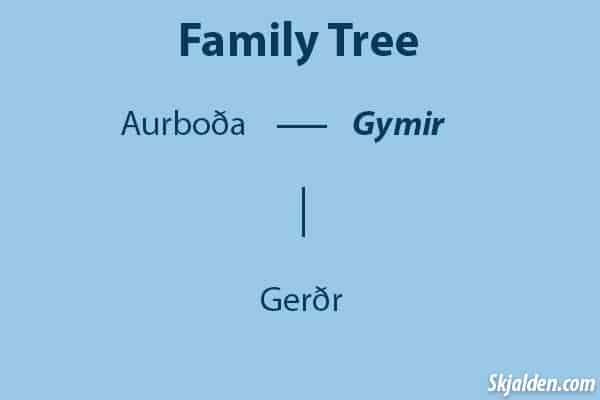
Gymir is a jötunn in Norse mythology and the father of Gerd, the giantess Freyr falls in love with in Skírnismál. He lives in Jötunheim with his wife, Aurboda, but he remains largely in the background of his daughter’s story. Unlike many of the better-known giants, Gymir has no surviving myth of his own and no stated role in the events that follow.
The poem still gives a small impression of his household. When Freyr’s messenger tries to win Gerd with gold, she dismisses the offer by saying: “In Gymir’s home is no lack of gold, in the wealth my father wields.” It is one of the few details the sources give about him. Gymir is wealthy, and the father of one of Norse mythology’s most important giantesses — but the story is never really about him.
Gymir and the Wooing of Gerd
Gymir’s importance comes from his place in Skírnismál (“The Lay of Skírnir”). Freyr sees Gerd from afar and becomes so overwhelmed by his desire for her that he sends his servant Skírnir to Jötunheim to speak with her. Skírnir does not go empty-handed. Before leaving, he asks Freyr for his horse and magical, self-fighting sword.
At Gymir’s home, Skírnir first offers Gerd gifts. She refuses them, including the gold that she says her father already has in abundance. He then turns to threats and, finally, a curse. Gerd agrees to meet Freyr in nine days.
Gymir himself does not intervene. He does not receive Freyr’s sword, approve the arrangement, or negotiate on his daughter’s behalf. The exchange is between Freyr’s servant and Gerd, while her father remains an important but silent presence behind the setting.
Is Gymir Actually Ægir?
Gymir becomes more interesting outside Gerd’s story. In Skáldskaparmál, Snorri Sturluson lists three names for the sea-jötunn: Ægir, Gymir, and Hlér. This creates a puzzle: is Gerd’s father also Ægir, or is Gymir simply a name poets could use for him?
The surviving text does not explain the relationship clearly. It may preserve an older tradition in which Gymir and Ægir were the same figure. It may also reflect poetic naming, where one giant’s name could be used for another in verse. No surviving source gives a final answer.
Even Gymir’s name remains uncertain. Scholars have connected it with meanings such as “the earthly one,” “the wintry one,” and “the engulfer” — possibilities that point in different directions, fitting for a figure who appears briefly in one myth but may also be connected to the sea-jötunn Ægir.
Gymir: Quick Answers
Who is Gymir’s daughter? Gerd, who later marries Freyr after his servant Skírnir negotiates on his behalf.
Did Gymir receive Freyr’s sword? No. Freyr gives the sword to Skírnir as payment for wooing Gerd — Gymir is not part of that exchange.
Is Gymir the same as Ægir? Possibly. Snorri Sturluson’s Skáldskaparmál lists Gymir as one of three names — alongside Ægir and Hlér — for the same sea-jötunn, though the sources do not explain their exact relationship.
What does Gymir’s name mean? Its meaning is uncertain. Proposed translations include “the earthly one,” “the wintry one,” and “the engulfer.”
Sources:
Lee M. Hollander (1962) The Poetic Edda. 15th edition. Texas, USA: University Research Institute of the University of Texas. ISBN 978-0-292-76499-6 — includes Skírnismál, source for the wooing of Gerd.