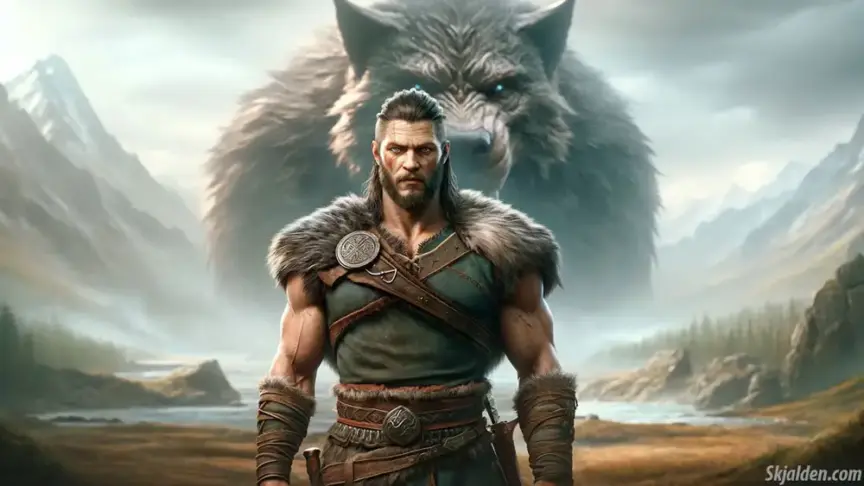
Tyr (Old Norse Týr) is the Norse god of war — but more specifically, he’s the god the Norse turned to for justice, oaths, and fair treaties. Snorri Sturluson calls him the bravest of the gods in Norse mythology, and his own myth explains why: he’s brave enough to put his hand into the jaws of the wolf Fenrir while the other gods bind it, knowing full well what the wolf might do if it realized what was happening.
Tyr is associated with the day Tuesday — in the Scandinavian countries, Danish and Norwegian still call Tuesday tirsdag, “Tyr’s day” — Swedish has the closely related tisdag.
Tyr may even be named on a find from 8th-century Denmark. A piece of human skull from the trading town of Ribe carries a runic inscription that names Odin. One possible reading, by the Danish runologist Erik Moltke, also calls on “High-Týr,” but the inscription is hard to read and that reading is uncertain.
Why did Tyr lose his hand in Norse mythology?
The one surviving myth that features Tyr prominently is the binding of Fenrir, told in Snorri’s Gylfaginning (ch. 25 and 34). The wolf Fenrir was growing at a terrifying rate, and the gods, fearing what he’d become, decided to bind him. The gods tried two ordinary chains first — Fenrir snapped the first one with no trouble at all, and broke the second only after a real struggle. So they sent for the dwarves to forge something stranger: Gleipnir, a binding shaped like a thin ribbon instead of a chain, made from six impossible things — the sound of a cat’s footsteps, a woman’s beard, a mountain’s roots, a bear’s sinews, a fish’s breath, and a bird’s spit.

Fenrir was suspicious of a binding that looked far too thin and weak to hold him. He agreed to be bound only if one god would place a hand in his mouth as a pledge of good faith. Every god refused except Tyr, who placed his right hand in the wolf’s mouth while the others fastened Gleipnir on. When Fenrir realized Gleipnir couldn’t be broken and the gods wouldn’t release him after all, he bit off Tyr’s hand.
It’s worth being precise about what happened here: the gods did deceive Fenrir, and Tyr was the one who paid for that deception with his hand. It’s a brave and costly act, not simply an honest bargain kept — and that mix of bravery and hard compromise is probably why this single story, more than any other, made him the god associated with both war and law. In the Eddic poem Sigrdrífumál, a valkyrie advises a warrior seeking victory to carve “victory runes” on his sword and invoke Tyr’s name twice — a real, if less specific, link between Tyr and battle-luck than the popular idea of carving a single T-shaped rune.
Is Tyr the Son of Odin, or the Giant Hymir?
The sources genuinely disagree on this, and it’s worth saying so plainly rather than picking one. In the Eddic poem Hymiskviða, Tyr calls the giant Hymir his father. But in Snorri’s Skáldskaparmál, Tyr is described plainly as “Son of Odin.”
The sources contradict each other, and nothing in what survives resolves it. Some modern interpretations suggest Hymir may be a foster-father rather than a biological one — fosterage by a giant does show up elsewhere in Norse myth — but that remains speculation, not a settled conclusion.
Why Is Tyr Both a War God and a God of Law?
Tyr’s association with both war and law is pieced together from different kinds of evidence, not stated outright in any one source. The Eddas call him a god of battles and give him the decisive, costly role in Fenrir’s binding. Separately, a 3rd-century Roman altar found at Housesteads, on Hadrian’s Wall, is dedicated to “Mars Thincsus” — Mars of the Thing, the Germanic legal assembly — set up by Frisian soldiers serving in the Roman army.
That altar is genuinely valuable evidence, but it’s worth being precise about what it proves: it’s strong evidence for a related war-and-law god tradition among continental Germanic peoples under Roman rule, not direct proof that the Viking Age Norse themselves understood Tyr specifically as a god of the legal assembly. Scholars debate how closely this continental “Mars Thincsus” figure connects to the Norse Tyr at all.
Snorri’s own description of Tyr cuts the other way, too. In Gylfaginning he writes plainly that Tyr “is not considered a promoter of settlements between people,” which is hardly the description of a peacemaker. So the “law god” label rests on scattered outside evidence and etymology, not on what Snorri himself says about him.
What Does the Lokasenna Say About Tyr?
Tyr also appears briefly in the Lokasenna, the poem where Loki insults every god at a feast in turn. Loki mocks Tyr for his missing hand, taunting that he could never make peace between two men — a cruel pun, since keeping peace between two parties normally takes two working hands. Tyr’s reply is short and unbothered: he lost a hand, but the wolf Fenrir lost its freedom, and it will stay bound until Ragnarök. It’s a small moment, but it shows Tyr taking his own sacrifice as a fair trade, not a grievance.
Tyr’s Ancient Roots: A Sky God Before Odin?
Tyr’s name comes from Proto-Germanic *Tiwaz, meaning “god” or “deity.” It’s linguistically related to the wider Indo-European sky-god vocabulary behind names like Zeus and Jupiter (from *Dyeus Phater, “Sky Father”) — the English word “deity” comes from this same root too. (The English word “day,” despite looking similar, actually comes from an unrelated root — a common mix-up worth avoiding.)
This has led some scholars to propose that Tyr may preserve traces of an older sky-god figure, predating Odin’s rise to become the Norse pantheon’s chief god. Lee M. Hollander, who translated the Poetic Edda, was one of them. In his notes he calls Tyr “originally doubtless the predecessor of Óthin.” But it’s worth being clear about the limits of this: the surviving Norse myths themselves never describe Tyr as a sky god. The connection is linguistic, not mythological.
How Will Tyr Die at Ragnarök?
According to Gylfaginning (ch. 51), Tyr is fated to fight Garmr, the monstrous hound associated with the cave Gnipahellir near Hel’s realm, at Ragnarök. The two kill each other in the fighting — a fitting end for a god whose entire surviving story is about paying a fair price rather than avoiding one.
How Reliable Are These Accounts?
Tyr is a genuine puzzle in Norse mythology: his name, his etymology, and scattered fragments like the Housesteads inscription all point to a god who was once hugely important to the wider Germanic peoples — important enough to be equated with Zeus and Mars. But by the time the Eddas were written down in medieval Iceland, only one real myth about him survives in any detail. Whether that gap reflects a real decline in Tyr’s worship by the Viking Age, myths that were simply lost over time, or just the accidents of which texts happened to survive, isn’t something the evidence can settle either way.
Tyr: Quick Answers
Why did Tyr lose his hand? He placed it in the wolf Fenrir’s mouth as a pledge of good faith so the other gods could bind him with Gleipnir. When Fenrir realized he’d been tricked, he bit the hand off.
Is Tyr the son of Odin? The sources disagree and nothing resolves it. Skáldskaparmál calls him “Son of Odin,” but Hymiskviða names the giant Hymir as his father — possibly a foster-father, though that’s speculation, not a settled answer.
Why is Tyr the god of both war and law? It’s pieced together from separate evidence, not stated outright anywhere: the Eddas call him a battle god, while a Roman-era altar (“Mars Thincsus”) links a related continental Germanic god to the legal assembly. How directly that connects to the Norse Tyr is debated.
How does Tyr die in Norse mythology? At Ragnarök, Tyr fights Garmr, the monstrous hound tied to Hel’s realm. The two kill each other.
Did Tyr’s day come from the Romans? Not Tyr himself — only the idea of a seven-day week, with days named for gods, did. That system started in Babylonian astrology, spread through the Hellenistic world, and reached Rome, which named a day Dies Martis, “Day of Mars,” after its war god. When Germanic peoples adopted the seven-day week from contact with Rome, they kept the structure but swapped in their own, already-existing native gods for the Roman ones, based on shared role — a substitution scholars call interpretatio germanica. None of these gods came from Rome or from each other; only the calendar slot changed hands. The day once dedicated to Mars was given to Tyr instead; Mercury’s day went to Odin; Jupiter’s to Thor. Venus’s day is usually credited to Frigg (the linguistic evidence for the English name leans that way) — though this one is genuinely disputed, since some scholars argue it’s really Freya’s day instead, and others think Frigg and Freya may originally have been the same goddess. Before that borrowing, Germanic peoples already had their own way of tracking time: the Roman historian Tacitus describes them reckoning by nights and lunar cycles, with no seven-day week at all.
Was Tyr more important than Odin once? His name’s origin (Proto-Germanic *Tiwaz, related to the sky-god root behind Zeus and Jupiter) has led some scholars to suggest he preserves traces of an older sky-god figure — but the Norse myths themselves never describe him that way, so this stays a linguistic clue, not a confirmed mythological fact.
Sources: